- [Korean]
- Corrosion Layer Removal from 304L Stainless Steel and Airborne Particle Generation and Filtration under Different Laser Scanning Conditions
-
Hyun Jong Yoo, Changkyoo Park, Jeoung Han Kim
-
Received August 12, 2026 Accepted October 12, 2026 Published online October 15, 2026
-
DOI: https://doi.org/10.4150/jpm.2026.00199
-
-
 Abstract
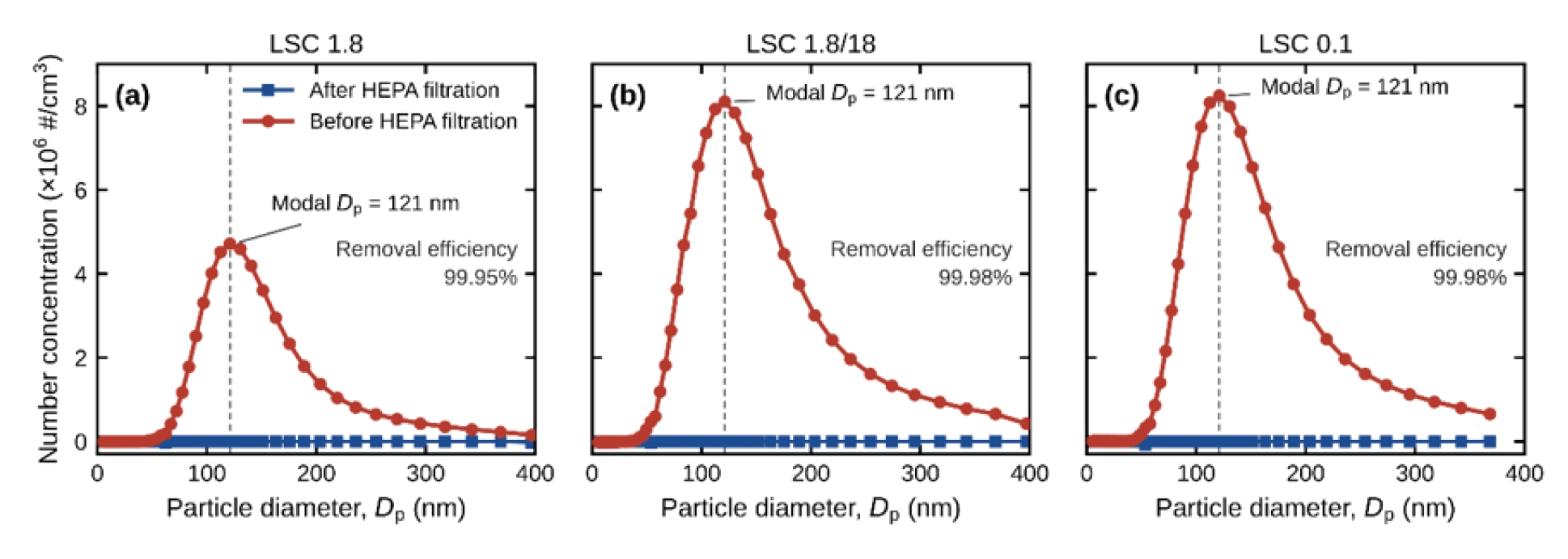
- Laser surface cleaning (LSC) can remove corrosion layers without chemicals or abrasives but releases airborne particles that require control for safe industrial use. We cleaned artificially corroded 304L stainless steel with a 1200 W nanosecond Nd:YAG laser using three scanning strategies: a single pass with a 1.8 mm hatch distance (LSC 1.8), 18 offset passes at 1.8 mm (LSC 1.8/18), and a single pass at 0.1 mm (LSC 0.1). Residual corrosion products remained after LSC 1.8, whereas LSC 1.8/18 and LSC 0.1 removed the corrosion layer. Peak particle number concentrations were 4.71 × 10⁶, 7.67 × 10⁶, and 8.25 × 10⁶ #/cm³, respectively, and modal diameters ranged from 112 to 121 nm. After normalization by the thickness of the removed layer, peak concentrations differed by only about 1.4% between LSC 1.8/18 and LSC 0.1, indicating that the concentration difference was mainly associated with the amount of material removed. Transmission electron microscopy showed agglomerates of nanoscale primary particles joined by necks; energy-dispersive X-ray spectroscopy and selected-area electron diffraction identified Fe–Cr–O particles with a spinel structure consistent with (Fe,Cr)₃O₄. H13-grade high-efficiency particulate air filtration achieved particle removal efficiencies of 99.95–99.98% across all conditions.
|
 KPMI