- [Korean]
- Pressure-Dependent Resistivity of Commercial Nickel Powders with Different Morphologies and Sieve Classes for Pressure-Conductive Rubber Semiconductor Test Sockets
-
DongWook Lee, MoonJung Kim
-
Received September 22, 2026 Accepted October 13, 2026 Published online October 19, 2026
-
DOI: https://doi.org/10.4150/jpm.2026.00255
-
-
 Abstract
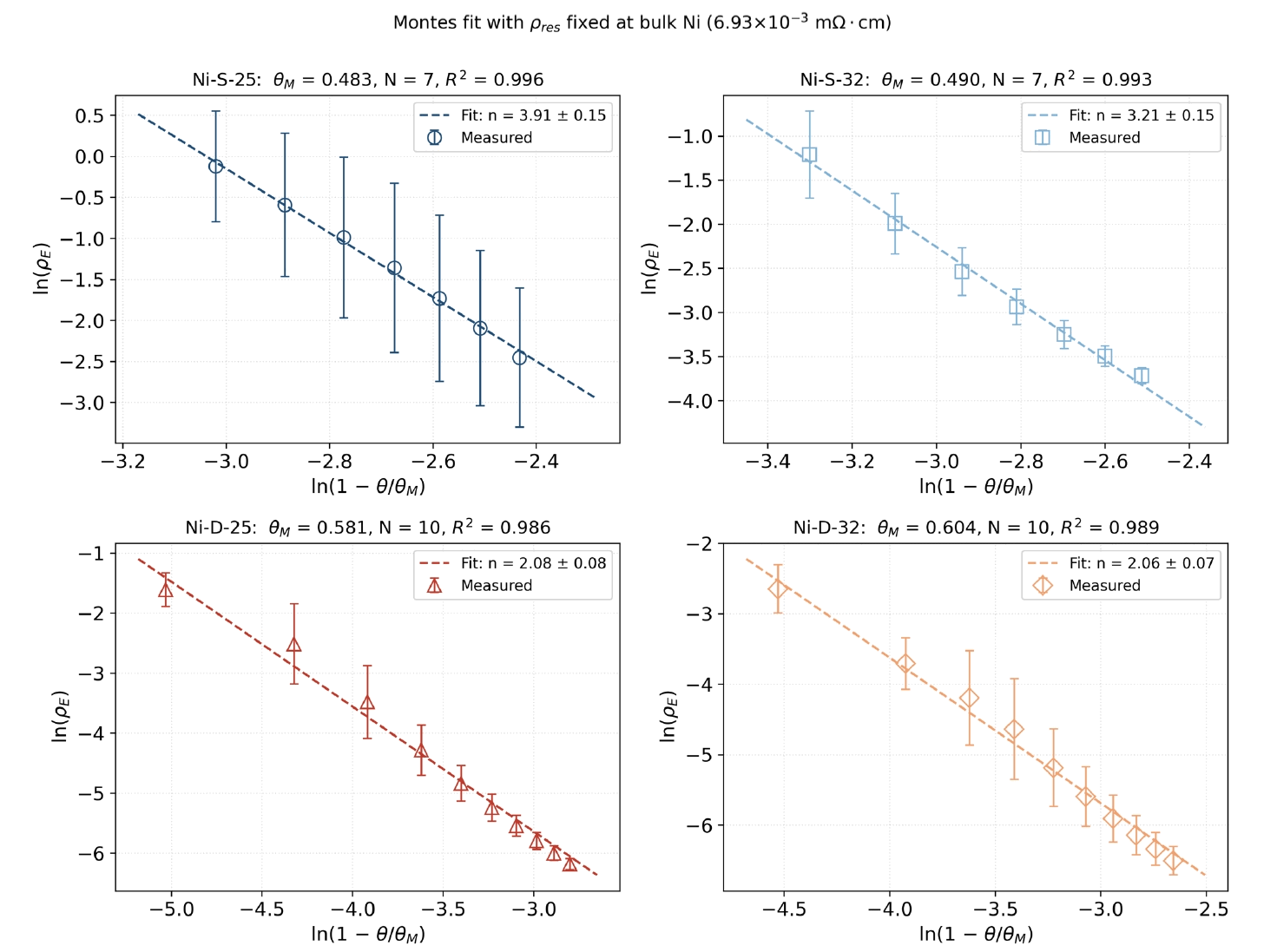
- Pressure-conductive rubber (PCR) sockets rely on Ni powder fillers. We characterized four commercial Ni powders of two morphologies (spherical and dendritic) and two sieve classes (25–32 and 32–45 μm) using laser diffraction, N₂ adsorption, He pycnometry, scanning electron microscopy, and four-point powder resistivity at 2.6–25.7 MPa. Sieve subclassification had little effect on specific surface area, true density, or resistivity, whereas the spherical and dendritic groups differed markedly; as the two morphologies came from different suppliers, this is a combined morphology/supplier effect. Dendritic powders conducted in all three replicates at the lowest pressure (2.6 MPa), whereas spherical powders did so only from 10.3 MPa, with partial conduction at 7.7 MPa. At matched pressures, the groups differed by a factor of 16–70 (1.5 vs 86 mΩ•cm at 25.7 MPa). Despite lower packing fractions, dendritic powders had lower resistivity, consistent with contact topology, not packing density, governing conduction. With residual resistivity fixed at the bulk Ni value, the Montes compaction model described all specimens (R² = 0.986–0.996) with group-dependent exponents (n ≈ 2.1 dendritic, 3.2–3.9 spherical). These findings support using pressure-dependent powder resistivity to prescreen candidate Ni fillers before PCR socket prototyping.
|
 KPMI