- [English]
- Optimization of VIGA Process Parameters for Power Characteristics of Fe-Si-Al-P Soft Magnetic Alloy using Machine Learning
-
Sung-Min Kim, Eun-Ji Cha, Do-Hun Kwon, Sung-Uk Hong, Yeon-Joo Lee, Seok-Jae Lee, Kee-Ahn Lee, Hwi-Jun Kim
-
J Powder Mater. 2022;29(6):459-467. Published online December 1, 2022
-
DOI: https://doi.org/10.4150/KPMI.2022.29.6.459
-
-
1,646
View
-
17
Download
-
1
Citations
-
 Abstract  PDF
Soft magnetic powder materials are used throughout industries such as motors and power converters. When manufacturing Fe-based soft magnetic composites, the size and shape of the soft magnetic powder and the microstructure in the powder are closely related to the magnetic properties. In this study, Fe-Si-Al-P alloy powders were manufactured using various manufacturing process parameter sets, and the process parameters of the vacuum induction melt gas atomization process were set as melt temperature, atomization gas pressure, and gas flow rate. Process variable data that records are converted into 6 types of data for each powder recovery section. Process variable data that recorded minute changes were converted into 6 types of data and used as input variables. As output variables, a total of 6 types were designated by measuring the particle size, flowability, apparent density, and sphericity of the manufactured powders according to the process variable conditions. The sensitivity of the input and output variables was analyzed through the Pearson correlation coefficient, and a total of 6 powder characteristics were analyzed by artificial neural network model. The prediction results were compared with the results through linear regression analysis and response surface methodology, respectively. -
Citations
Citations to this article as recorded by  - Microstructure, Magnetic Properties, and Performance of Fe-6.5Si Soft Magnetic Core Produced by Laser Powder Bed Fusion
Ji Sang Yoon, Yeon Woo Kim, Gyu Hyun Park, Youk Jin Kim, Sang Heon Lee, Jeong Seok Kim, Sung Ho Yu, Jeong Min Park
Journal of Powder Materials.2026; 33(3): 177. CrossRef
- [Korean]
- Micro-deformation behavior of Brittle Hf-based Metallic Glass during Mechanical Milling
-
Song-Yi Kim, A-Young Lee, Eun-Ji Cha, Do-Hun Kwon, Sung-Uk Hong, Min-Woo Lee, Hwi-Jun Kim, Min-Ha Lee
-
J Korean Powder Metall Inst. 2018;25(3):246-250. Published online June 1, 2018
-
DOI: https://doi.org/10.4150/KPMI.2018.25.3.246
-
-
Abstract
PDF
In this study, we investigate the deformation behavior of Hf44.5Cu27Ni13.5Nb5Al10 metallic glass powder under repeated compressive strain during mechanical milling. High-density (11.0 g/cc) Hf-based metallic glass powders are prepared using a gas atomization process. The relationship between the mechanical alloying time and microstructural change under phase transformation is evaluated for crystallization of the amorphous phase. Planetary mechanical milling is performed for 0, 40, or 90 h at 100 rpm. The amorphous structure of the Hf-based metallic glass powders during mechanical milling is analyzed using differential scanning calorimetry (DSC) and X-ray diffraction (XRD). Microstructural analysis of the Hf-based metallic glass powder deformed using mechanical milling reveals a layered structure with vein patterns at the fracture surface, which is observed in the fracture of bulk metallic glasses. We also study the crystallization behavior and the phase and microstructure transformations under isothermal heat treatment of the Hf-based metallic glass.
- [Korean]
- Microstructural Characteristics and High-Temperature Compression Behavior of a Ni-Based ODS-Composition Alloy and Refractory Composite
-
Song-Yi Kim, Do-Hun Kwon, Eun-Ji Cha, Hwi-Jun Kim
-
Received September 11, 2026 Accepted October 13, 2026 Published online October 19, 2026
-
DOI: https://doi.org/10.4150/jpm.2026.00234
-
-
Abstract
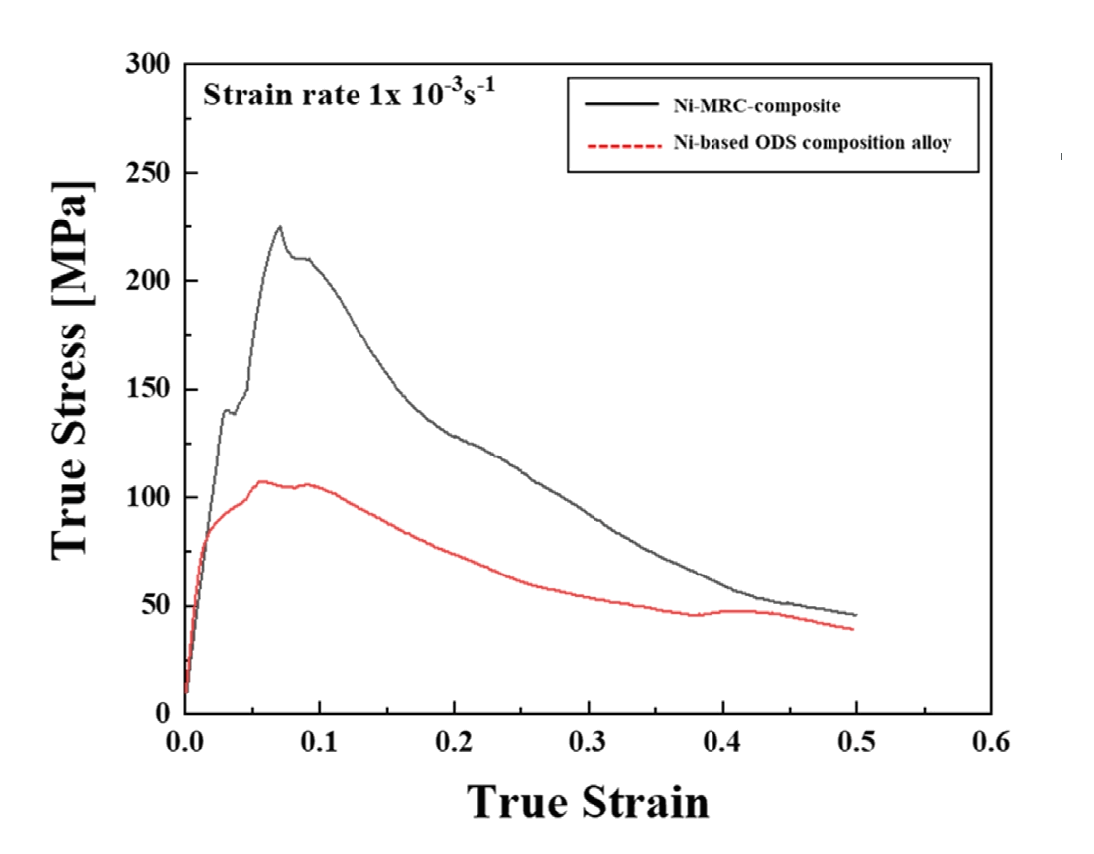
- Nickel-based alloys have been widely used as high-temperature structural materials owing to their excellent oxidation resistance, phase stability, and mechanical reliability. However, their mechanical properties can rapidly deteriorate under ultrahigh-temperature conditions due to thermally activated dislocation motion, dynamic recovery, and grain-boundary-mediated deformation. Therefore, introducing thermally stable refractory constituents that retain high strength at elevated temperatures may provide an effective strategy for overcoming this limitation. In this study, Nb-Si-Ti-based refractory silicide alloy powder and Mo-based refractory alloy powder were introduced as reinforcing constituents to improve the ultrahigh-temperature deformation resistance of a Ni-based ODS-composition alloy. A Ni-MRC composite was fabricated by spark plasma sintering. The composite powder consisted of 65 wt.% Ni-based ODS-composition alloy powder, 25 wt.% Nb-Si-Ti-based refractory silicide alloy powder, and 10 wt.% Mo-based refractory alloy powder. Powder morphology, phase constitution, SPS-consolidated microstructure and ultrahigh-temperature compression behavior at 1050 °C were analyzed using SEM, XRD, EBSD, and Gleeble-based compression testing to evaluate the role of refractory reinforcements in improving the deformation resistance of the Ni-based matrix. The Ni-MRC composite exhibited a peak stress of 221 MPa at 1050 ℃, approximately 106% higher than that of the Ni-based ODS-composition alloy, indicating improved ultrahigh-temperature deformation resistance.
|
 KPMI