- [English]
- Influence of Cobalt Content on Phase Formation and Morphology in Co-Zn-O Oxides
-
Deukhyeon Nam, Sungdo Yun, Bo Eun Choi, Chan Woong Na, Yoon Myung
-
J Powder Mater. 2026;33(2):104-112. Published online April 30, 2026
-
DOI: https://doi.org/10.4150/jpm.2026.00052
-
-
 Abstract Abstract
 PDF PDF
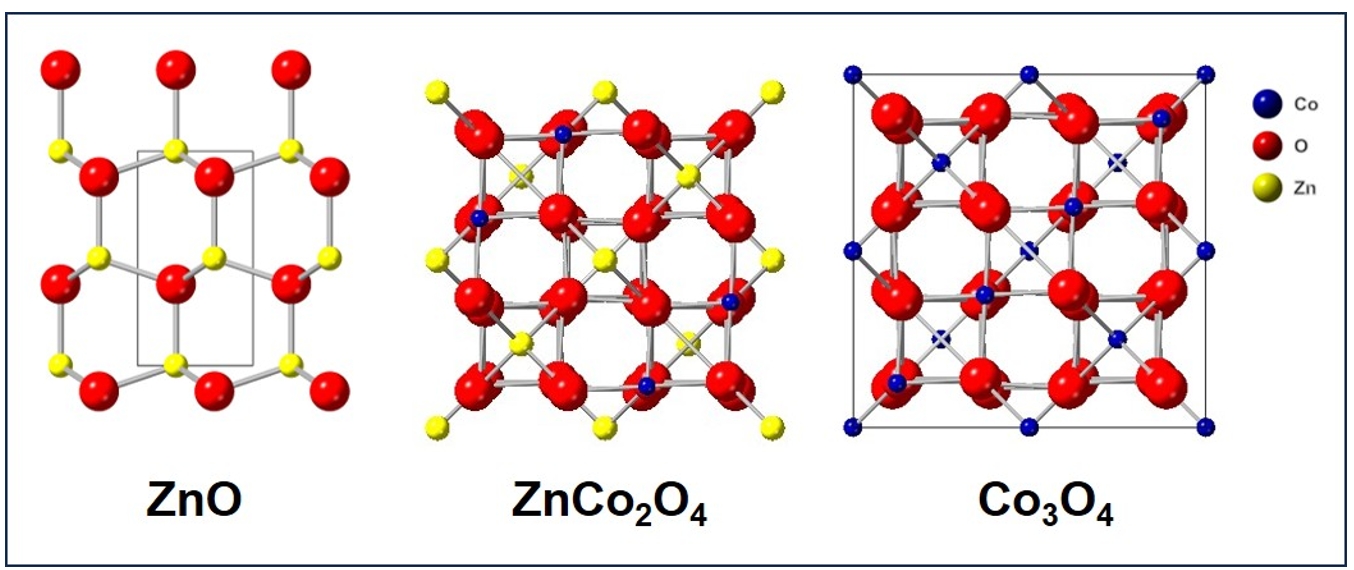
- Co–Zn–O–based materials have attracted attention for applications in energy storage and catalysis. In this study, the effects of cobalt incorporation on the crystal phase and particle morphology of Co–Zn–O oxides were investigated. ZnO-based oxides were synthesized using a reflux method, and the influence of cobalt content on phase formation and morphology was systematically evaluated. As the cobalt precursor concentration increased, scanning electron microscopy–energy dispersive X-ray spectroscopy confirmed higher cobalt incorporation. This compositional variation was accompanied by changes in particle morphology, including nanoparticles, disk-like structures, and occasional rod-like features. X-ray diffraction and Raman spectroscopy showed that samples with low cobalt content retained the wurtzite ZnO phase, whereas higher cobalt concentrations led to formation of a ZnO/ZnCo2O4 composite. X-ray photoelectron spectroscopy revealed comparable binding energies among samples, while differences in peak width suggested variations in the local coordination environment of cobalt. These results indicate that cobalt content significantly influences phase composition and particle morphology in Co–Zn–O oxides synthesized under reflux conditions.
- [Korean]
- Synthesis of the Multi-layered SnO Nanoparticles and Enhanced Performance of Lithium-Ion Batteries by Heat treatment
-
So Yi Lee, Yoon Myung, Kyu-Tae Lee, Jaewon Choi
-
J Korean Powder Metall Inst. 2021;28(6):455-461. Published online December 1, 2021
-
DOI: https://doi.org/10.4150/KPMI.2021.28.6.455
-
-
2,634
View
-
11
Download
-
1
Citations
-
Abstract
PDF
In this study, multilayered SnO nanoparticles are prepared using oleylamine as a surfactant at 165°C. The physical and chemical properties of the multilayered SnO nanoparticles are determined by transmission electron microscopy (TEM), scanning electron microscopy (SEM), energy-dispersive spectroscopy (EDS), X-ray diffraction (XRD), and X-ray photoelectron spectroscopy (XPS). Interestingly, when the multilayered SnO nanoparticles are heated at 400°C under argon for 2 h, they become more efficient anode materials, maintaining their morphology. Heat treatment of the multilayered SnO nanoparticles results in enhanced discharge capacities of up to 584 mAh/g in 70 cycles and cycle stability. These materials exhibit better coulombic efficiencies. Therefore, we believe that the heat treatment of multilayered SnO nanoparticles is a suitable approach to enable their application as anode materials for lithium-ion batteries. -
Citations
Citations to this article as recorded by  - Synthesis and electrochemical properties of multi-layered SnO/rGO composite as anode materials for sodium ion batteries
So Yi Lee, Honggyu Seong, Geongil Kim, Youngho Jin, Joon Ha Moon, Wonbin Nam, Sung Kuk Kim, MinHo Yang, Jaewon Choi
Applied Surface Science.2023; 612: 155859. CrossRef
|
 KPMI
KPMI