 KPMI


Search
- Page Path
- HOME > Search
- [English]
- Thermite-Assisted Cu-Coated Al Powder as a Solid Propellant: Expanding the Use of Coarse Al Powder
- Soo-ho Jung, Jinhee Bae, Ji Hun Yu, Ho sung Kim, Soo Hyung Kim
- J Powder Mater. 2026;33(5):356-364. Published online October 30, 2026
- DOI: https://doi.org/10.4150/jpm.2026.00206
- 358 View
- 6 Download
-
 Abstract
 PDF
 Supplementary Material
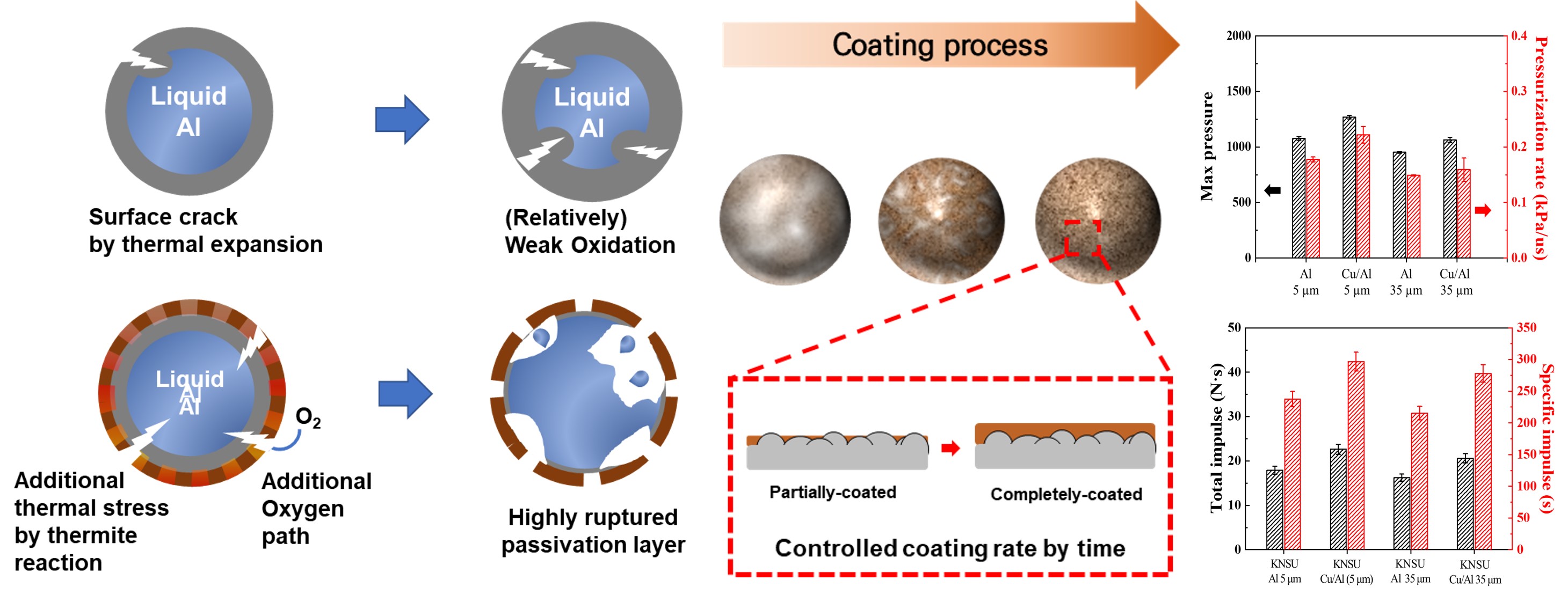
- Aluminum (Al) powder is a key fuel for solid propellants, but its native oxide (Al2O3) layer acts as a diffusion barrier, resulting in incomplete combustion. Although coarse Al powders offer excellent handling stability, their reactivity is considerably lower. To address this limitation, we coated Al powders with copper (Cu) by electroless plating to form a dual-layer shell with an outer Cu layer and an inner Al2O3 layer. During combustion, the Cu layer induces a thermite reaction at the powder surface, generating intense thermal stress that ruptures the dense oxide shell and promotes oxidation of the internal Al core. Thermogravimetric analysis and differential scanning calorimetry showed higher reactivity and significantly greater heat release in the Cu-coated Al (Cu/Al) powders. In combustion and propulsion tests, the 35 μm Cu/Al powder achieved maximum explosion pressures and pressurization rates comparable to those of pristine 5 μm Al powder, together with a higher specific impulse. This surface modification improves the combustion efficiency of coarse Al powders and offers a promising route to high-performance solid propellants. However, the reduced margin against electrostatic discharge must be considered during handling.
- [Korean]
- The Effects of TiC Content on Microstructure of Modified A6013-3wt.%Si Alloy Powder Compact
- Hyo-Sang Yoo, Yong-Ho Kim, Hyeon-Taek Son
- J Powder Mater. 2022;29(1):28-33. Published online February 1, 2022
- DOI: https://doi.org/10.4150/KPMI.2022.29.1.28

- 1,855 View
- 8 Download
- 1 Citations
-
Abstract
PDF
Aluminum-based powders have attracted attention as key materials for 3D printing owing to their low density, high specific strength, high corrosion resistance, and formability. This study describes the effects of TiC addition on the microstructure of the A6013 alloy. The alloy powder was successfully prepared by gas atomization and further densified using an extrusion process. We have carried out energy dispersive X-ray spectrometry (EDS) and electron backscatter diffraction (EBSD) using scanning electron microscopy (SEM) in order to investigate the effect of TiC addition on the microstructure and texture evolution of the A6013 alloy. The atomized A6013-xTiC alloy powder is fine and spherical, with an initial powder size distribution of approximately 73 μm which decreases to 12.5, 13.9, 10.8, and 10.0 μm with increments in the amount of TiC.
-
Citations
Citations to this article as recorded by
- Influence of Curing Agent Amount on Properties of Dynamic Vulcanized Phenyl Silicone Rubber-SEBS-SBS System
Chunxu Zhao, Bobing He, Xian Chen
Polymers.2022; 14(24): 5443. CrossRef
- Influence of Curing Agent Amount on Properties of Dynamic Vulcanized Phenyl Silicone Rubber-SEBS-SBS System
- [Korean]
- Effect of Sn Addition on Microstructure of Al Alloy Powder for Brazing Process
- Yong-Ho Kim, Hyo-Sang Yoo, Sang-Su Na, Hyeon-Taek Son
- J Korean Powder Metall Inst. 2020;27(2):139-145. Published online April 1, 2020
- DOI: https://doi.org/10.4150/KPMI.2020.27.2.139

- 1,278 View
- 4 Download
-
Abstract
PDF
The powder manufacturing process using the gas atomizer process is easy for mass production, has a fine powder particle size, and has excellent mechanical properties compared to the existing casting process, so it can be applied to various industries such as automobiles, electronic devices, aviation, and 3D printers. In this study, a modified A4032-xSn (x = 0, 1, 3, 5, and 10 wt.%) alloy with low melting point properties is investigated. After maintaining an argon (Ar) gas atmosphere, the main crucible is tilted; containing molten metal at 1,000°C by melting the master alloy at a high frequency, and Ar gas is sprayed at 10 bar gas pressure after the molten metal inflow to the tundish crucible, which is maintained at 800°C. The manufactured powder is measured using a particle size analyzer, and FESEM is used to observe the shape and surface of the alloy powder. DSC is performed to investigate the change in shape, according to the melting point and temperature change. The microstructure of added tin (Sn) was observed by heat treatment at 575°C for 10 min. As the content of Sn increased, the volume fraction increased to 1.1, 3.1, 6.4, and 10.9%.
 First
 Prev


TOP

