 KPMI
KPMI

Search
- Page Path
- HOME > Search
Research Article
- [Korean]
- Effect of Milling-Time-Dependent Zirconia Contamination on the Microstructure and Mechanical Properties of Mechanically Alloyed Multicomponent Nb-Si-Ti Sintered Alloys
- Deokhyun Han, Seo-Yu Lee, Jin-Seo Park, Jeong-Sik Moon, Jungjoon Kim, Youngkyun Kim, Byungmin Ahn
- J Powder Mater. 2026;33(4):291-298. Published online August 31, 2026
- DOI: https://doi.org/10.4150/jpm.2026.00178
- 396 View
- 7 Download
-
 Abstract
 PDF
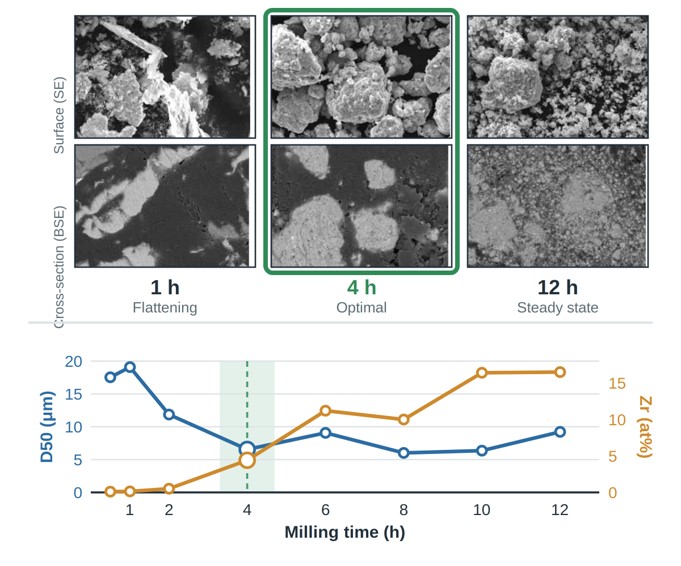
PDF - Multicomponent Nb-15Si-23Ti-3Cr-2Sn-2Al-2Hf-1B-0.5Y alloy powders were synthesized by high-energy ball milling using a zirconia chamber and balls for milling times of 0.5–12 h, and the effects of milling time on powder evolution, contamination behavior, and the resulting microstructure and mechanical properties of hot-pressed sintered specimens were systematically investigated. The dominant deformation mechanism shifted from flattening to cold welding and then to a fracture- dominated steady state with increasing milling time, and the particle size decreased sharply up to 4 h before stabilizing. Yield and composition analyses showed that zirconia contamination remained limited up to 4 h but increased sharply beyond 6 h owing to severe wear of the milling chamber and balls. Sintered specimens from powder milled for 4 h exhibited a homogeneous microstructure with finely and stably dispersed Nb5Si3 intermetallic phases and moderate hardness, whereas insufficient milling for 2 h left coarse, unreacted phases, and excessive milling for 12 h introduced substantial zirconia contamination that lowered density while raising hardness. These results indicate that a milling time in the range of 4–6 h offers a favorable balance between alloying efficiency and contamination control, with 4 h being preferred owing to its comparatively minimal zirconia contamination.
 First
First Prev
Prev

TOP

