 KPMI


Search
- Page Path
- HOME > Search
- [Korean]
- Microstructural Characteristics and High-Temperature Compression Behavior of a Ni-Based ODS-Composition Alloy and Refractory Composite
- Song-Yi Kim, Do-Hun Kwon, Eun-Ji Cha, Hwi-Jun Kim
- J Powder Mater. 2026;33(5):365-371. Published online October 30, 2026
- DOI: https://doi.org/10.4150/jpm.2026.00234
- 155 View
- 5 Download
-
 Abstract
 PDF
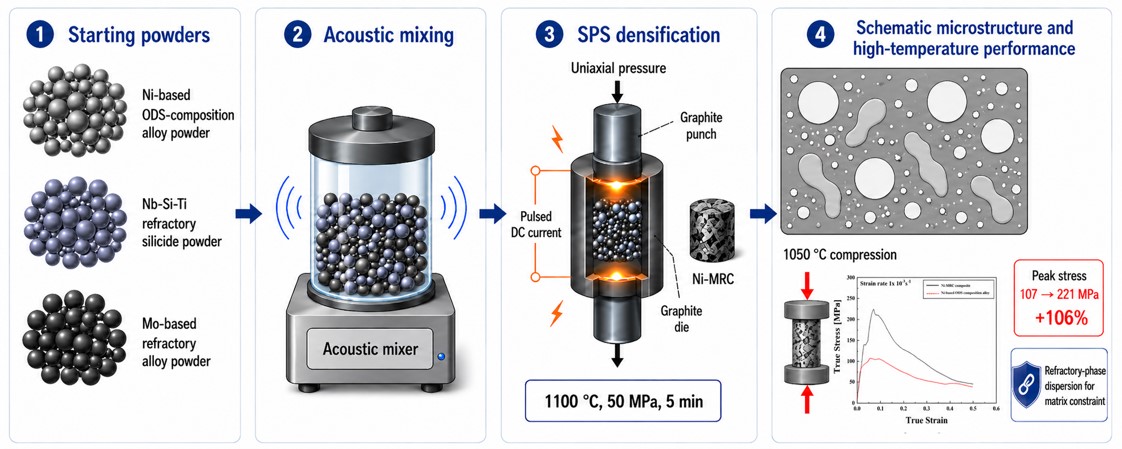
- Nickel-based alloys have been widely used as high-temperature structural materials owing to their excellent oxidation resistance, phase stability, and mechanical reliability. However, their mechanical properties can rapidly deteriorate under ultrahigh-temperature conditions due to thermally activated dislocation motion, dynamic recovery, and grain-boundary-mediated deformation. Therefore, introducing thermally stable refractory constituents that retain high strength at elevated temperatures may provide an effective strategy for overcoming this limitation. In this study, Nb-Si-Ti-based refractory silicide alloy powder and Mo-based refractory alloy powder were introduced as reinforcing constituents to improve the ultrahigh-temperature deformation resistance of a Ni-based ODS-composition alloy. A Ni-MRC composite was fabricated by spark plasma sintering. The composite powder consisted of 65 wt.% Ni-based ODS-composition alloy powder, 25 wt.% Nb-Si-Ti-based refractory silicide alloy powder, and 10 wt.% Mo-based refractory alloy powder. Powder morphology, phase constitution, SPS-consolidated microstructure and ultrahigh-temperature compression behavior at 1050 °C were analyzed using SEM, XRD, EBSD, and Gleeble-based compression testing to evaluate the role of refractory reinforcements in improving the deformation resistance of the Ni-based matrix. The Ni-MRC composite exhibited a peak stress of 221 MPa at 1050 ℃, approximately 106% higher than that of the Ni-based ODS-composition alloy, indicating improved ultrahigh-temperature deformation resistance.
- [Korean]
- Microstructure and High Temperature Mechanical Properties of Oxide Dispersion Strengthened Steels Manufactured by Combination Milling Process
- Jung-Uk Lee, Young-Kyun Kim, Jeoung Han Kim, Hwi-Jin Kim, Kee-Ahn Lee
- J Korean Powder Metall Inst. 2021;28(5):389-395. Published online October 1, 2021
- DOI: https://doi.org/10.4150/KPMI.2021.28.5.389
- 1,394 View
- 10 Download
-
Abstract
PDF
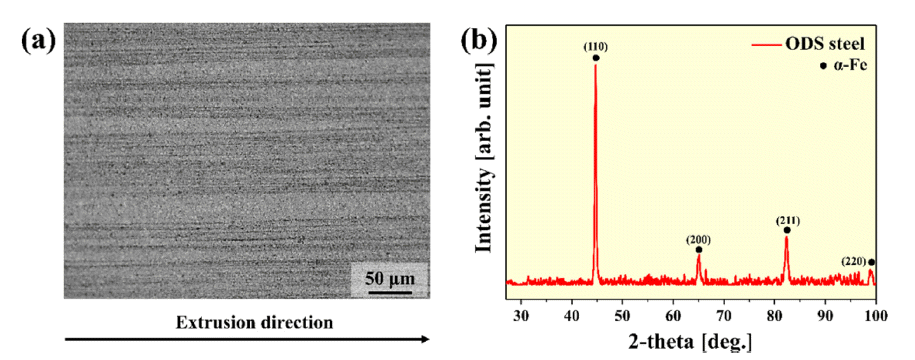
Oxide dispersion-strengthened (ODS) steel has excellent high-temperature properties, corrosion resistance, and oxidation resistance, and is expected to be applicable in various fields. Recently, various studies on mechanical alloying (MA) have been conducted for the dispersion of oxide particles in ODS steel with a high number density. In this study, ODS steel is manufactured by introducing a complex milling process in which planetary ball milling, cryogenic ball milling, and drum ball milling are sequentially performed, and the microstructure and high-temperature mechanical properties of the ODS steel are investigated. The microstructure observation revealed that the structure is stretched in the extrusion direction, even after the heat treatment. In addition, transmission electron microscopy (TEM) analysis confirmed the presence of oxide particles in the range of 5 to 10 nm. As a result of the room-temperature and high-temperature compression tests, the yield strengths were measured as 1430, 1388, 418, and 163 MPa at 25, 500, 700, and 900°C, respectively. Based on these results, the correlation between the microstructure and mechanical properties of ODS steel manufactured using the composite milling process is also discussed.
 First
 Prev


TOP

