 KPMI
KPMI

Search
- Page Path
- HOME > Search
- [Korean]
- Effect of Milling-Time-Dependent Zirconia Contamination on the Microstructure and Mechanical Properties of Mechanically Alloyed Multicomponent Nb-Si-Ti Sintered Alloys
- Deokhyun Han, Seo-Yu Lee, Jin-Seo Park, Jeong-Sik Moon, Jungjoon Kim, Youngkyun Kim, Byungmin Ahn
- J Powder Mater. 2026;33(4):291-298. Published online August 31, 2026
- DOI: https://doi.org/10.4150/jpm.2026.00178
- 396 View
- 7 Download
-
 Abstract
 PDF
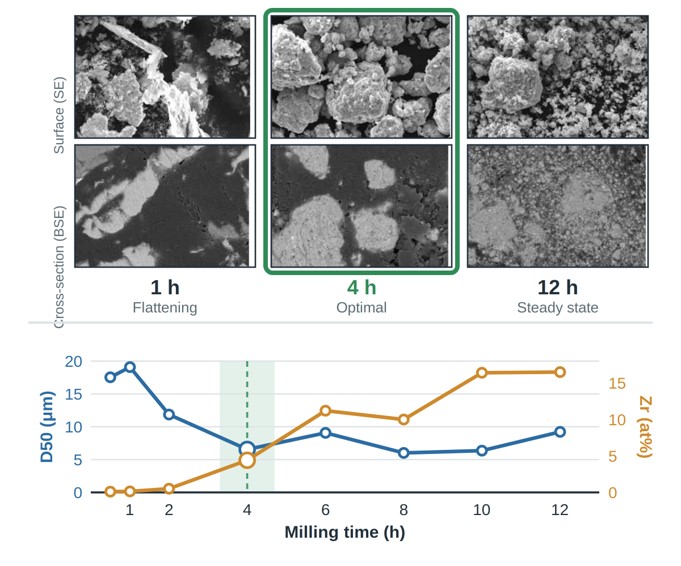
PDF - Multicomponent Nb-15Si-23Ti-3Cr-2Sn-2Al-2Hf-1B-0.5Y alloy powders were synthesized by high-energy ball milling using a zirconia chamber and balls for milling times of 0.5–12 h, and the effects of milling time on powder evolution, contamination behavior, and the resulting microstructure and mechanical properties of hot-pressed sintered specimens were systematically investigated. The dominant deformation mechanism shifted from flattening to cold welding and then to a fracture- dominated steady state with increasing milling time, and the particle size decreased sharply up to 4 h before stabilizing. Yield and composition analyses showed that zirconia contamination remained limited up to 4 h but increased sharply beyond 6 h owing to severe wear of the milling chamber and balls. Sintered specimens from powder milled for 4 h exhibited a homogeneous microstructure with finely and stably dispersed Nb5Si3 intermetallic phases and moderate hardness, whereas insufficient milling for 2 h left coarse, unreacted phases, and excessive milling for 12 h introduced substantial zirconia contamination that lowered density while raising hardness. These results indicate that a milling time in the range of 4–6 h offers a favorable balance between alloying efficiency and contamination control, with 4 h being preferred owing to its comparatively minimal zirconia contamination.
- [Korean]
- Development of Hybrid Insulating Coating for Fe-based Soft Magnetic Powder
- Jungjoon Kim, Sungyeom Kim, Youngkyun Kim, Taesuk Jang, Hwi-jun Kim, Youngjin Kim, Hyunjoo Choi
- J Korean Powder Metall Inst. 2021;28(3):233-238. Published online June 1, 2021
- DOI: https://doi.org/10.4150/KPMI.2021.28.3.233

- 1,011 View
- 7 Download
-
Abstract
PDF
Iron-based amorphous powder attracts increasing attention because of its excellent soft magnetic properties and low iron loss at high frequencies. The development of an insulating layer on the surface of the amorphous soft magnetic powder is important for minimizing the eddy current loss and enhancing the energy efficiency of highfrequency devices by further increasing the electrical resistivity of the cores. In this study, a hybrid insulating coating layer is investigated to compensate for the limitations of monolithic organic or inorganic coating layers. Fe2O3 nanoparticles are added to the flexible silicon-based epoxy layer to prevent magnetic dilution; in addition TiO2 nanoparticles are added to enhance the mechanical durability of the coating layer. In the hybrid coating layer with optimal composition, the decrease in magnetic permeability and saturation magnetization is suppressed.
 First
First Prev
Prev

TOP

