 KPMI


Search
- Page Path
- HOME > Search
- [English]
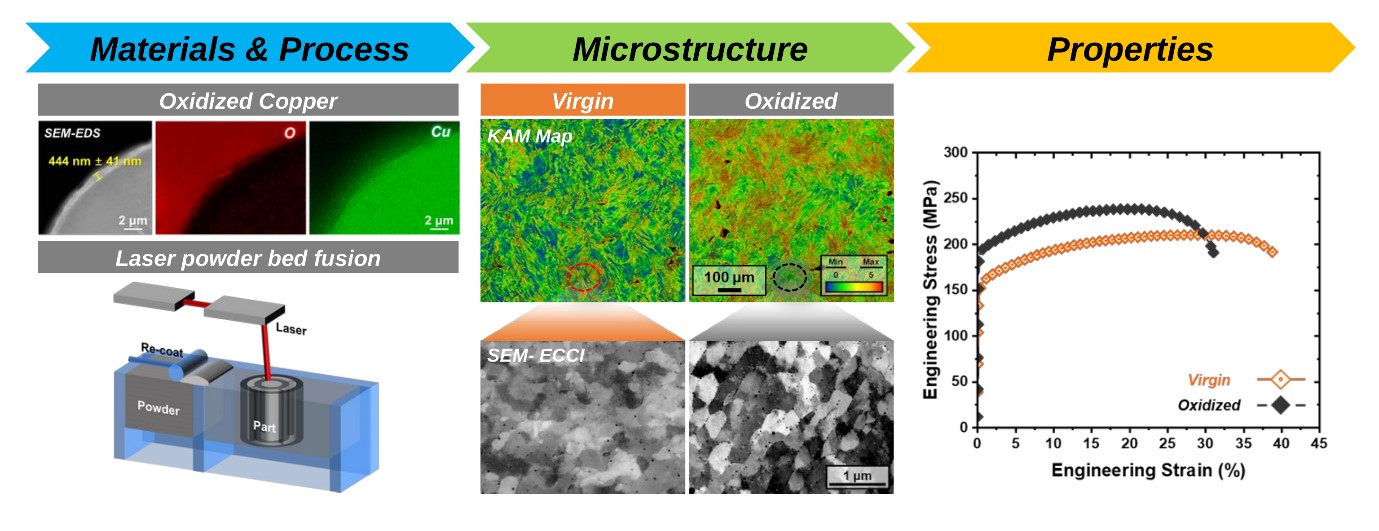
- Role of Oxides in the Tensile Properties of Pure Copper Processed by Laser Powder Bed Fusion
- Haeum Park, Ki Jong Kim, Yeon Woo Kim, Hahun Lee, Kichul Park, Yerim Kim, Kee-Ahn Lee, Seok Su Sohn, Jeong Min Park
- J Powder Mater. 2026;33(5):372-378. Published online October 30, 2026
- DOI: https://doi.org/10.4150/jpm.2026.00248
- 158 View
- 3 Download
-
 Abstract
 PDF
- Oxide particles can affect the tensile properties of pure Cu processed by laser powder bed fusion (LPBF) through their interactions with dislocations. This study compared the microstructure and tensile behavior of samples produced from virgin and oxidized pure Cu powders under identical LPBF conditions. The two samples had comparable relative densities above 98.7% and similar grain sizes. Yield and ultimate tensile strengths were nevertheless higher in the oxidized sample, whereas uniform and total elongations were lower. Backscattered-electron imaging and image analysis indicated that oxide particles occupied a higher apparent area fraction in the examined fields of the oxidized sample; electron backscatter diffraction analysis also showed higher kernel average misorientation. Together, these observations suggest two possible roles for oxide particles: acting as dispersed obstacles to dislocation motion and promoting dislocation retention during LPBF, consistent with the higher kernel average misorientation. The strength increase may therefore reflect both particle strengthening and a greater contribution from dislocation strengthening.
- [Korean]
- Microstructure and Tensile Deformation Behavior of Ni-Cr-Al Powder Porous Block Material
- Chul-O Kim, Jung-Suk Bae, Kee-Ahn Lee
- J Korean Powder Metall Inst. 2015;22(2):93-99. Published online April 1, 2015
- DOI: https://doi.org/10.4150/KPMI.2015.22.2.93

- 1,379 View
- 9 Download
- 2 Citations
-
Abstract
PDF
This study investigated the microstructure and tensile properties of a recently made block-type Ni-Cr-Al powder porous material. The block-type powder porous material was made by stacking multiple layers of powder porous thin plates with post-processing such as additional compression and sintering. This study used block-type powder porous materials with two different cell sizes: one with an average cell size of 1,200 μm (1200 foam) and the other with an average cell size of 3,000 μm (3000 foam). The γ-Ni and γ’-Ni3Al were identified as the main phases of both materials. However, in the case of the 1,200 foam, a β-NiAl phase was additionally observed. The relative density of each block-type powder porous material, with 1200 foam and 3000 foam, was measured to be 5.78% and 2.93%, respectively. Tensile tests were conducted with strain rates of 10−2~10−4 sec−1. The test result showed that the tensile strength of the 1,200 foam was 6.0~7.1 MPa, and that of 3,000 foam was 3.0~3.3 MPa. The elongation of the 3,000 foam was higher (~9%) than that (~2%) of the 1,200 foam. This study also discussed the deformation behavior of block-type powder porous material through observations of the fracture surface, with the results above.
-
Citations
Citations to this article as recorded by
- Effect of Strut Thickness on Room and High Temperature Compressive Properties of Block-Type Ni-Cr-Al Powder Porous Metals
B.-H. Kang, M.-H. Park, K.-A. Lee
Archives of Metallurgy and Materials.2017; 62(2): 1329. CrossRef - Fabrication and Shape Memory Characteristics of Highly Porous Ti-Nb-Mo Biomaterials
Y.-W. Kim, T.W. Mukarati
Archives of Metallurgy and Materials.2017; 62(2): 1367. CrossRef
- Effect of Strut Thickness on Room and High Temperature Compressive Properties of Block-Type Ni-Cr-Al Powder Porous Metals
 First
 Prev


TOP

