 KPMI
KPMI

Search
- Page Path
- HOME > Search
Research Article
- [English]
- Mechanical Behavior of Aluminum Matrix Composites Reinforced with Nanoscale Carbon Nanotubes and Silicon Carbide
- Kanhu Charan Nayak, Jiwon Lee, Kon-Bae Lee, Ke Jiang, Hyunjoo Choi
- J Powder Mater. 2026;33(4):267-280. Published online August 31, 2026
- DOI: https://doi.org/10.4150/jpm.2026.00164
- 482 View
- 9 Download
-
 Abstract
 PDF
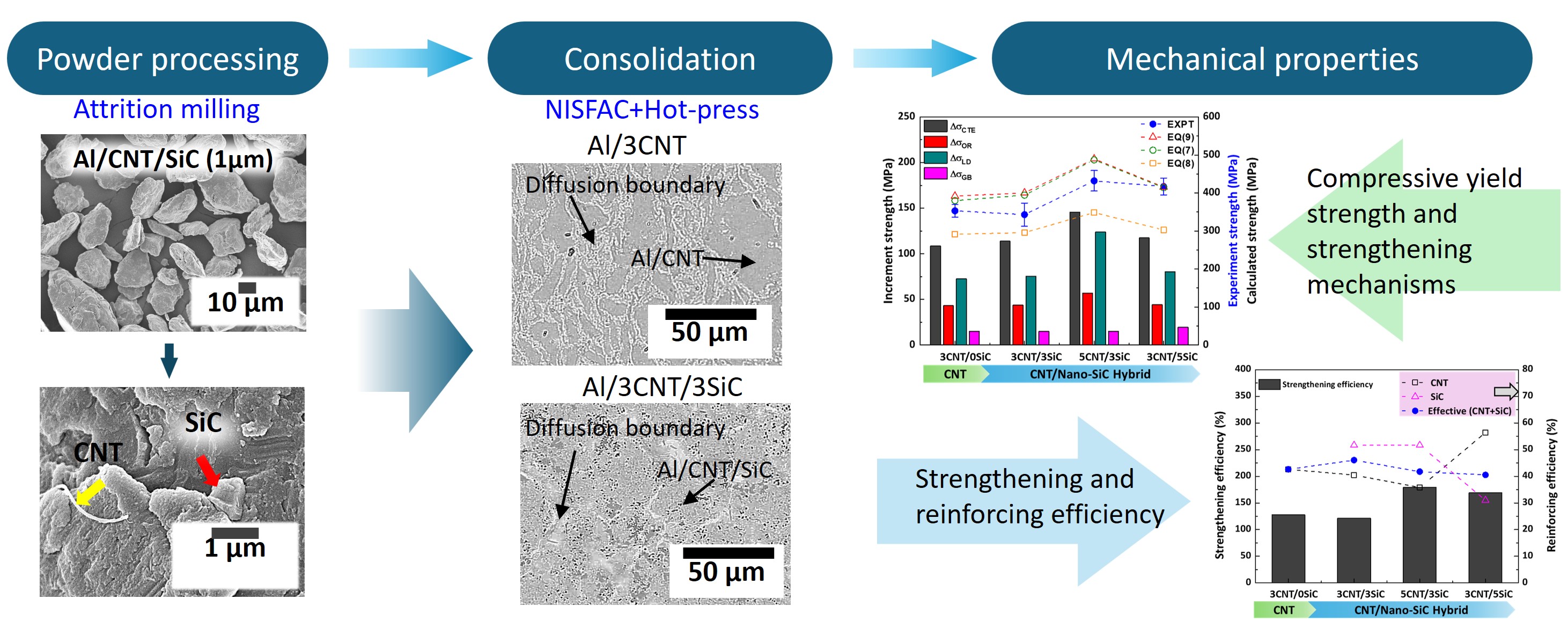
PDF - Lightweight aluminum (Al) matrix composites reinforced with carbon nanotubes (CNTs) and nanoscale silicon carbide (SiC) were fabricated using high-energy attrition milling, nitridation-induced self-forming consolidation (NISFAC), and hot pressing to improve mechanical performance through CNT/SiC hybrid reinforcement. Attrition milling refined the composite powders and promoted the incorporation of CNTs and SiC particles into the Al matrix, whereas NISFAC and hot pressing enabled near-full densification and effective interparticle bonding. Among the investigated compositions, Al/5CNT/3SiC showed the best mechanical performance, with a hardness of 197 HV, compressive yield strength of 432 MPa, compressive strength of 756 MPa, and Young’s modulus of 110 GPa. These improvements are attributed to the combined effects of load transfer, thermal-mismatch-induced dislocation strengthening, Orowan strengthening, and grain-boundary strengthening. Compared with values reported in the literature, the present composites showed competitive mechanical properties despite their relatively low reinforcement content. These findings indicate that CNT/SiC hybrid reinforcement combined with NISFAC and hot pressing is an effective route for producing dense, high-strength Al matrix composites.
- [Korean]
- Applications of Nanomanipulator in Nanowires
- Sang-Won Yoon, Jong-Hyun Seo, Jae-Pyoung Ahn, Tae-Yeon Seong, Kon-Bae Lee
- J Korean Powder Metall Inst. 2009;16(2):138-145.
- DOI: https://doi.org/10.4150/KPMI.2009.16.2.138
- 811 View
- 0 Download
-
Abstract
PDF
- The combination of focused ion beam (FIB) and 4 point probe nanomanipulator could make various nano manufacturing and electrical measurements possible. In this study, we manufactured individual ZnO nanowire devices and measured those electrical properties. In addition, tensile experiments of metallic Au and Pd nanowires was performed by the same directional alignment of two nanomanipulators and a nanowire. It was confirmed from I-V curves that Ohmic contact is formed between electrodes and nanomanipulators, which is able to directly measure the electrical properties of a nanowire itself. In the mechanical tensile test, Au and Pd nanowires showed a totally different fracture behavior except the realignment from <110> to <002>. The deformation until the fracture was governed by twin for Au and by slip for Pd nanowires, respectively. The crystallographic relationship and fracture mechanism was discussed by TEM observations.
 First
First Prev
Prev

TOP

