 KPMI
KPMI

Search
- Page Path
- HOME > Search
Research Article
- [English]
- Structural, Electrical, and Optical Properties of Al–Mg Co-Doped ZnO Thin Films
- Jong-Mu Kim, Jun-Seo Park, Jun-Ha Lee, Min-Woo Kim, Jung-Woo Lee
- J Powder Mater. 2026;33(1):44-50. Published online February 28, 2026
- DOI: https://doi.org/10.4150/jpm.2026.00031
- 1,884 View
- 29 Download
-
 Abstract
 PDF
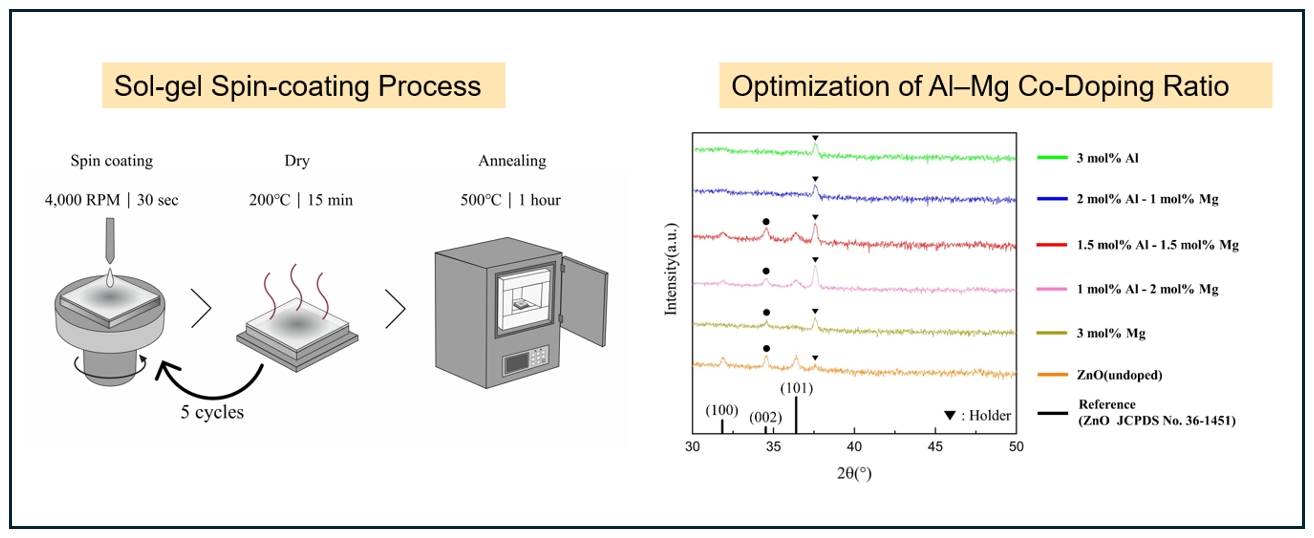
PDF - Al–Mg co-doped ZnO thin films were fabricated by a sol–gel spin-coating process to investigate the effect of dopant ratio on their structural, electrical, and optical properties. The total dopant concentration was fixed at 3 mol%, while the Al-to-Mg ratio was systematically varied in AlₓMg₀.₀₃₋ₓZn₀.₉₇O (0 ≤ x ≤ 0.03). X-ray diffraction analysis showed that the films maintained a hexagonal wurtzite structure with a preferred (002) orientation up to an Al concentration of 1.5 mol%, whereas higher Al contents resulted in a degradation of crystallinity due to exceeding the solid solubility limit of Al in the ZnO lattice. Hall effect measurements revealed a decrease in carrier mobility with increasing Al content, attributed to enhanced ionized impurity scattering, while the carrier concentration and electrical conductivity reached optimal values at an Al–Mg co-doping ratio of 1.5 mol%–1.5 mol%. All films exhibited high optical transmittance in the visible region, with the highest average transmittance of approximately 83% observed at the same composition. These results demonstrate that controlling the Al/Mg dopant ratio is crucial for optimizing the performance of ZnO-based transparent conducting oxide thin films.
- [Korean]
- Texture and Mechanical Properties of Ni-W Alloy Tapes Fabricated from Powder Mother Billets
- Min-Woo Kim, Byung-Hyuk Jun, Bong-Ki Ji, Kyu-Dong Jung, Chan-Joong Kim
- J Korean Powder Metall Inst. 2007;14(1):13-18.
- DOI: https://doi.org/10.4150/KPMI.2007.14.1.013
- 1,322 View
- 0 Download
- 1 Citations
-
Abstract
PDF
- The mother Ni-W (1-5 wt.%) alloy billets for coated conductor substrate were fabricated by powder metallurgy process. The tensile test results for the sintered Ni-W rods showed the increase of mechanical strength and decrease of ductility with increasing W content due to the solid solution hardening. All the fracture surfaces of the tested specimens showed the typical ductile fracture mode of dimple rupture due to the local necking. The Ni-W alloy billets were made into tape by cold rolling. After the appropriate heat treatment for recrystallization, the brass texture formed by the cold rolling was converted to the complete cube texture. The in-plane and out of plane texture of the tapes estimated by x-ray pole figure were smaller than 9 degree and 7 degree, respectively. The effect of the W addition on the texture development seems not to be significant.
-
Citations
Citations to this article as recorded by
- Production of textured ribbons based on Ni–W paramagnetic alloys
V.A. Finkel
Functional Materials.2013; 20(1): 103. CrossRef
- Production of textured ribbons based on Ni–W paramagnetic alloys
 First
First Prev
Prev

TOP

