 KPMI


Search
- Page Path
- HOME > Search
Research Articles
- [English]
- Role of Oxides in the Tensile Properties of Pure Copper Processed by Laser Powder Bed Fusion
- Haeum Park, Ki Jong Kim, Yeon Woo Kim, Hahun Lee, Kichul Park, Yerim Kim, Kee-Ahn Lee, Seok Su Sohn, Jeong Min Park
- J Powder Mater. 2026;33(5):372-378. Published online October 30, 2026
- DOI: https://doi.org/10.4150/jpm.2026.00248
- 126 View
- 2 Download
-
 Abstract
 PDF
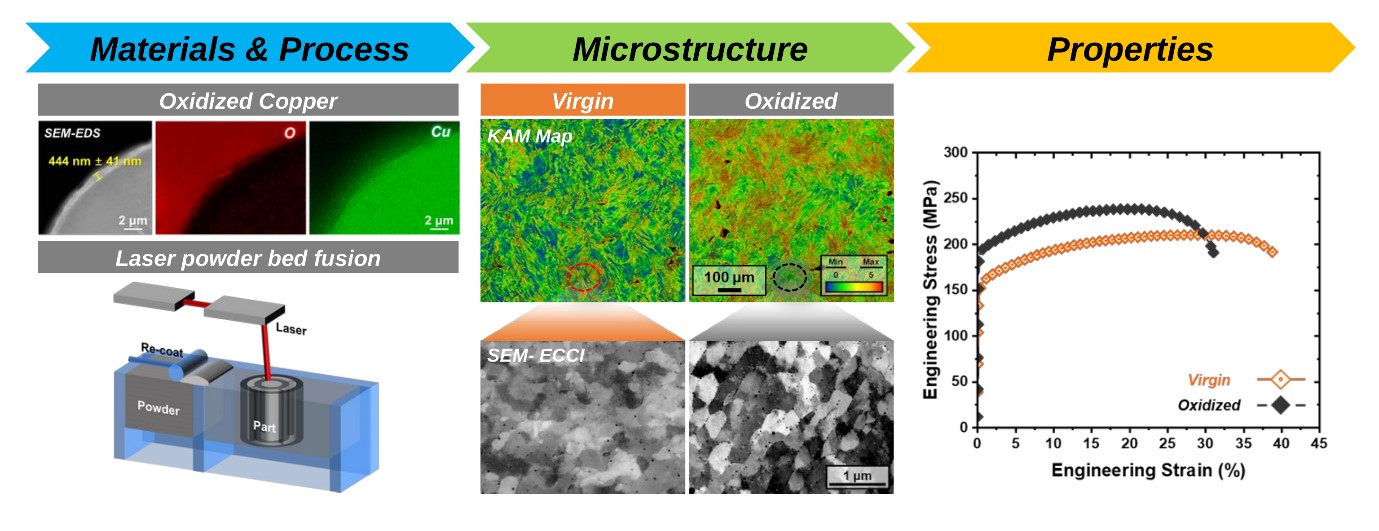
- Oxide particles can affect the tensile properties of pure Cu processed by laser powder bed fusion (LPBF) through their interactions with dislocations. This study compared the microstructure and tensile behavior of samples produced from virgin and oxidized pure Cu powders under identical LPBF conditions. The two samples had comparable relative densities above 98.7% and similar grain sizes. Yield and ultimate tensile strengths were nevertheless higher in the oxidized sample, whereas uniform and total elongations were lower. Backscattered-electron imaging and image analysis indicated that oxide particles occupied a higher apparent area fraction in the examined fields of the oxidized sample; electron backscatter diffraction analysis also showed higher kernel average misorientation. Together, these observations suggest two possible roles for oxide particles: acting as dispersed obstacles to dislocation motion and promoting dislocation retention during LPBF, consistent with the higher kernel average misorientation. The strength increase may therefore reflect both particle strengthening and a greater contribution from dislocation strengthening.
- [Korean]
- Effect of Building Orientation on Tensile Properties of Hastelloy X alloy Manufactured by Laser Powder Bed Fusion
- Seong-June Youn, GooWon Noh, Seok Su Sohn, Young-Sang Na, Young-Kyun Kim
- J Powder Mater. 2025;32(2):131-137. Published online April 30, 2025
- DOI: https://doi.org/10.4150/jpm.2025.00080
- 2,746 View
- 40 Download
- 1 Citations
-
Abstract
PDF
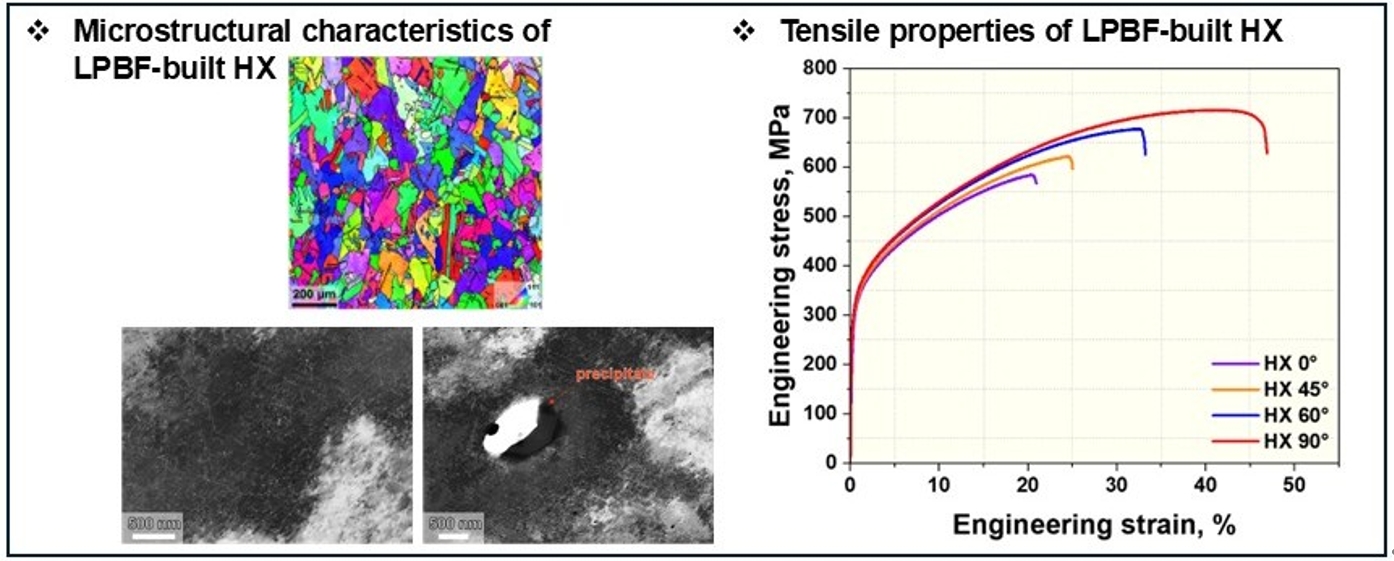
- In this study, the effect of build orientation on the mechanical properties of Hastelloy X fabricated by laser powder bed fusion (LPBF) process was investigated. Initial microstructural analysis revealed an equiaxed grain structure with random crystallographic orientation and annealing twins. Intragranular precipitates identified as Cr-rich M23C6 and Mo-rich M6C carbides were observed, along with a dense dislocation network and localized dislocation accumulation around the carbides. Mechanical testing showed negligible variation in yield strength with respect to build orientation; however, both ultimate tensile strength and elongation exhibited a clear increasing trend with higher build angles. Notably, the specimen built at 90° exhibited approximately 22% higher tensile strength and more than twice the elongation compared to the 0° specimen.
-
Citations
Citations to this article as recorded by
- Ultra-Low Temperature Mechanical Response of Laser Powder Bed Fusion–Processed C-Containing CoCrFeMnNi High-Entropy Alloy
Jae-Yong Cheon, Seong-June Youn, Young-Sang Na, Young-Kyun Kim
Journal of Powder Materials.2026; 33(3): 195. CrossRef
- Ultra-Low Temperature Mechanical Response of Laser Powder Bed Fusion–Processed C-Containing CoCrFeMnNi High-Entropy Alloy
- [English]
- Hot-Cracking Behaviors in (CoNi)85Mo15 Medium-Entropy Alloys Manufactured via Powder Bed Fusion
- Seungjin Nam, Heechan Jung, Haeum Park, Chahee Jung, Jeong Min Park, Hyoung Seop Kim, Seok Su Sohn
- J Powder Mater. 2024;31(6):537-545. Published online December 31, 2024
- DOI: https://doi.org/10.4150/jpm.2024.00262

- 3,005 View
- 37 Download
- 1 Citations
-
Abstract
PDF
- Additive manufacturing makes it possible to improve the mechanical properties of alloys through segregation engineering of specific alloying elements into the dislocation cell structure. In this study, we investigated the mechanical and microstructural characteristics of CoNi-based medium-entropy alloys (MEAs), including the refractory alloying element Mo with a large atomic radius, manufactured via laser-powder bed fusion (L-PBF). In an analysis of the printability depending on the processing parameters, we achieved a high compressive yield strength up to 653 MPa in L-PBF for (CoNi)85Mo15 MEAs. However, severe residual stress remained at high-angle grain boundaries, and a brittle µ phase was precipitated at Mo-segregated dislocation cells. These resulted in hot-cracking behaviors in (CoNi)85Mo15 MEAs during L-PBF. These findings highlight the need for further research to adjust the Mo content and processing techniques to mitigate cracking behaviors in L-PBF-manufactured (CoNi)85Mo15 MEAs.
-
Citations
Citations to this article as recorded by- Effect of Support Structure on Residual Stress Distribution in Ti-6Al-4V Alloy Fabricated by Laser Powder Bed Fusion
Seungyeon Lee, Haeum Park, Min Jae Baek, Dong Jun Lee, Jae Wung Bae, Ji-Hun Yu, Jeong Min Park
Journal of Powder Materials.2025; 32(3): 244. CrossRef
- Effect of Support Structure on Residual Stress Distribution in Ti-6Al-4V Alloy Fabricated by Laser Powder Bed Fusion
 First
 Prev


TOP

