 KPMI


Search
- Page Path
- HOME > Search
Research Articles
- [English]
- Effect of Low-Oxygen Atmosphere Sintering on TiO2 Powder Photoanodes for Fiber-Shaped Dye-Sensitized Solar Cells toward Carbon-Based Electrode Integration.
- Yeonggwon Kim, Chae Young Woo, Sung Min Kim, Jiseong Park, Yongseon Jeong, Dabin Chun, Seungfeel Jeong, Hyung Woo Lee
- J Powder Mater. 2026;33(5):327-337. Published online October 30, 2026
- DOI: https://doi.org/10.4150/jpm.2026.00241
- 141 View
- 6 Download
-
 Abstract
 PDF
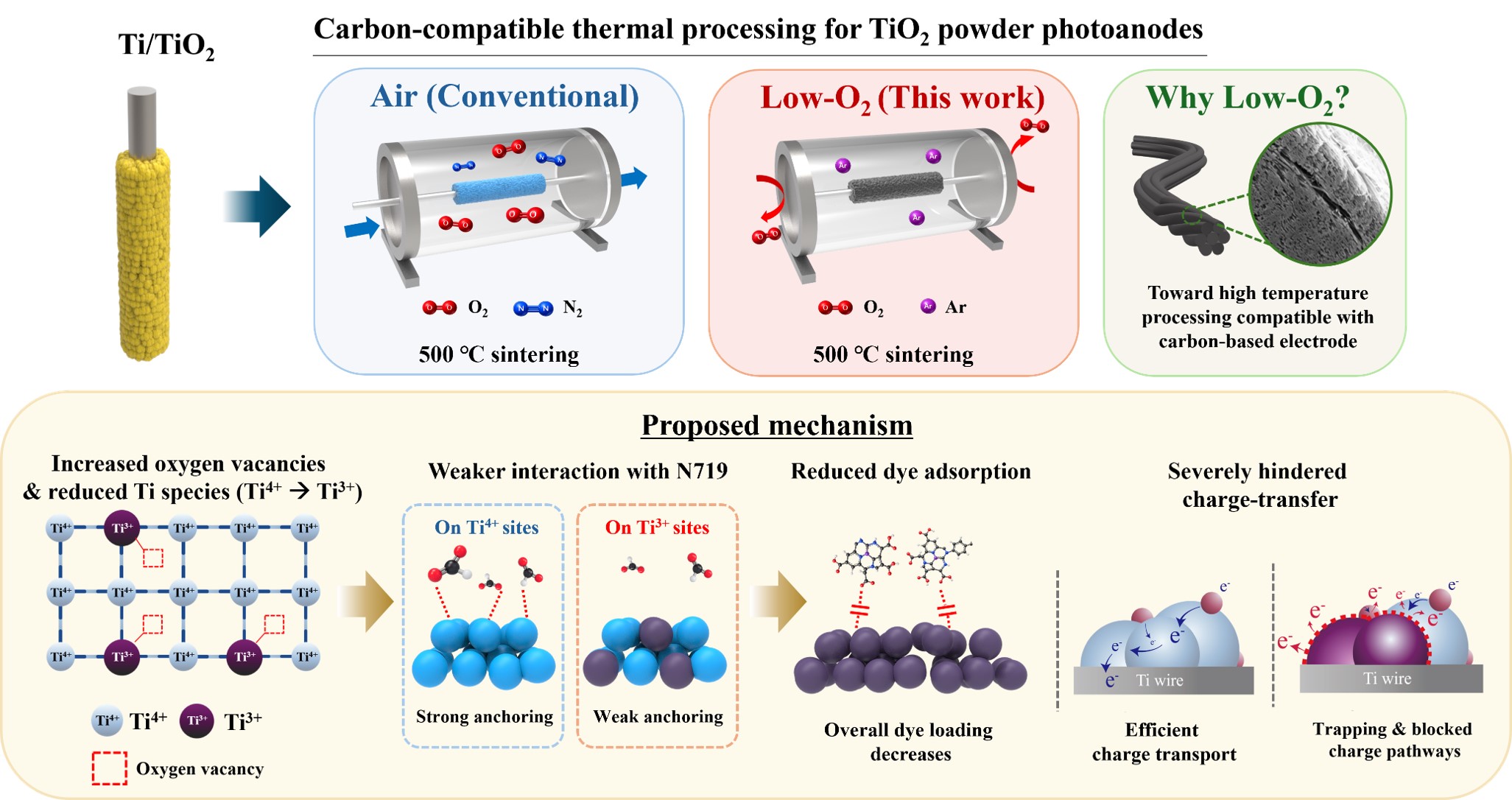
- Motivated by the goal of achieving high-temperature photoanode processing compatible with carbon-based current collectors, this study investigates the effect of sintering atmosphere on Ti wire/TiO2 photoanodes for fiber-shaped dye-sensitized solar cells. Photoanodes sintered under conventional air (Air) and a custom low-oxygen condition (LO, continuous Ar flow under reduced pressure at 500 °C) were compared, along with a subsequent low-temperature air-annealing treatment (LO-A). X-ray diffraction (XRD) and scanning electron microscopy (SEM) revealed no substantial difference between Air and LO, whereas X-ray photoelectron spectroscopy (XPS) showed a marked increase in reduced Ti species (Ti3+, Ti2+) and an approximately twofold higher C 1s signal for LO, accompanied by significantly reduced N719 dye adsorption. LO photoanodes exhibited short-circuit-like device behavior, precluding reliable photovoltaic characterization. Although LO-A eliminated this short-circuit behavior and largely restored dye adsorption, photovoltaic performance remained severely suppressed, and electrochemical impedance spectroscopy revealed a three-orders-of-magnitude increase in photoanode-related charge-transfer resistance relative to Air. These results indicate that dye-anchoring capacity and interfacial charge-transfer resistance are governed by at least partially distinct factors, possibly involving reduced Ti species, carbon residue, and leakage paths, whose contributions were not separated, and that low-temperature annealing alone is insufficient to restore the photoelectrochemical functionality compromised by LO sintering.
- [English]
- The Effect of a CNT/MnO2 Nanoparticle Composite–Based Multi-Shell Typed Electrode for a Fiber Supercapacitor (FSC)
- Yeonggwon Kim, Hyung Woo Lee
- J Powder Mater. 2025;32(1):30-36. Published online February 28, 2025
- DOI: https://doi.org/10.4150/jpm.2024.00416

- 7,734 View
- 28 Download
-
Abstract
PDF
- Fiber supercapacitors have attracted significant interest as potential textile energy storage devices due to their remarkable flexibility and rapid charge/discharge capabilities. This study describes the fabrication of a composite fiber supercapacitor (FSC) electrode through a multi-shell architecture, featuring layers of carbon nanotube (CNT) conductive shells and MnO₂ nanoparticle active shells. The number of layers was adjusted to assess their impact on FSC energy storage performance. Increasing the number of shells reduced electrode resistance and enhanced pseudocapacitive characteristics. Compared to the MnS@1 electrode, the MnS@5 electrode exhibited a high areal capacitance of 301.2 mF/cm², a 411% increase, but showed a higher charge transfer resistance (RCT) of 701.6 Ω. This is attributed to reduced ion diffusion and charge transfer ability resulting from the thicker multi-shell configuration. These results indicate that fine-tuning the quantity of shells is crucial for achieving an optimal balance between energy storage efficiency and stability.
 First
 Prev


TOP

