 KPMI
KPMI

Search
- Page Path
- HOME > Search
- [Korean]
- Evaluation of Mechanical Properties of Pure Ni Coatings on a Type 316H Stainless Steel Substrate via High-Velocity Oxy-fuel and Directed Energy Deposition Processes
- Won Chan Lee, Seung Ju Nam, Ji-Hyun Yoon, Jeoung Han Kim
- J Powder Mater. 2025;32(4):309-314. Published online August 29, 2025
- DOI: https://doi.org/10.4150/jpm.2025.00185

- 1,296 View
- 11 Download
-
 Abstract
 PDF
PDF - This study compares pure Ni coatings deposited on type 316H stainless steel using high-velocity oxy-fuel (HVOF) and directed energy deposition (DED) processes. Microstructural analysis showed that DED produced more uniform claddings with fewer pores, while HVOF resulted in incomplete melting and cracks. Elemental diffusion of Cr and Fe from the substrate into the cladding was evident in DED samples, especially at higher laser power, but minimal in HVOF due to low heat input. Vickers hardness testing revealed that DED claddings had higher hardness near the interface, which was attributed to solid solution strengthening and reduced porosity. Although HVOF better suppressed diffusion, it exhibited inferior mechanical properties due to internal defects. Overall, the DED process demonstrated superior coating quality and mechanical performance, suggesting its suitability for corrosion-resistant applications requiring both structural integrity and thermal stability, such as molten salt reactors.
- [Korean]
- Tribological Behavior Analysis of WC-Ni-Cr + Cr3C2 and WC-Ni-Cr + YSZ Coatings Sprayed by HVOF
- Tae-Jun Park, Gye-Won Lee, Yoon-Suk Oh
- J Powder Mater. 2023;30(5):415-423. Published online October 1, 2023
- DOI: https://doi.org/10.4150/KPMI.2023.30.5.415

- 1,525 View
- 17 Download
-
Abstract
PDF
With the increasing attention to environmental pollution caused by particulate matter globally, the automotive industry has also become increasingly interested in particulate matter, especially particulate matter generated by automobile brake systems. Here, we designed a coating composition and analyzed its mechanical properties to reduce particulate matter generated by brake systems during braking of vehicles. We designed a composition to check the mechanical properties change by adding Cr3C2 and YSZ to the WC-Ni-Cr composite composition. Based on the designed composition, coating samples were manufactured, and the coating properties were analyzed by Vickers hardness and ball-on-disk tests. As a result of the experiments, we found that the hardness and friction coefficient of the coating increased as the amount of Cr3C2 added decreased. Furthermore, we found that the hardness of the coating layer decreased when YSZ was added at 20vol%, but the friction coefficient was higher than the composition with Cr3C2 addition.
- [Korean]
- Improvement of the Mechanical Property and Corrosion Resistivity of the Ni-/Fe-based Hybrid Coating Layer using High-velocity Oxygen Fuel Spraying by Heat Treatment
- Jungjoon Kim, Yeonjoo Lee, Song-Yi Kim, Jong-Jae Lee, Jae-hun Kim, Seok-Jae Lee, Hyunkyu Lim, Min-Ha Lee, Hwi-Jun Kim, Hyunjoo Choi
- J Powder Mater. 2022;29(3):240-246. Published online June 1, 2022
- DOI: https://doi.org/10.4150/KPMI.2022.29.3.240

- 1,473 View
- 8 Download
-
Abstract
PDF
Novel Ni- and Fe-based alloys are developed to impart improved mechanical properties and corrosion resistance. The designed alloys are manufactured as a powder and deposited on a steel substrate using a high-velocity oxygen-fuel process. The coating layer demonstrates good corrosion resistance, and the thus-formed passive film is beneficial because of the Cr contained in the alloy system. Furthermore, during low-temperature heat treatment, factors that deteriorate the properties and which may arise during high-temperature heat treatment, are avoided. For the heattreated coating layers, the hardness increases by up to 32% and the corrosion resistance improves. The influence of the heat treatment is investigated through various methods and is considered to enhance the mechanical properties and corrosion resistance of the coating layer.
- [Korean]
- Development of Amorphous Iron Based Coating Layer using High-velocity Oxygen Fuel (HVOF) Spraying
- Jungjoon Kim, Song-Yi Kim, Jong-Jae Lee, Seok-Jae Lee, Hyunkyu Lim, Min-Ha Lee, Hwi-Jun Kim, Hyunjoo Choi
- J Korean Powder Metall Inst. 2021;28(6):483-490. Published online December 1, 2021
- DOI: https://doi.org/10.4150/KPMI.2021.28.6.483

- 1,372 View
- 8 Download
-
Abstract
PDF
A new Fe-Cr-Mo-B-C amorphous alloy is designed, which offers high mechanical strength, corrosion resistance as well as high glass-forming ability and its gas-atomized amorphous powder is deposited on an ASTM A213-T91 steel substrate using the high-velocity oxygen fuel (HVOF) process. The hybrid coating layer, consisting of nanocrystalline and amorphous phases, exhibits strong bonding features with the substrate, without revealing significant pore formation. By the coating process, it is possible to obtain a dense structure in which pores are hardly observed not only inside the coating layer but also at the interface between the coating layer and the substrate. The coating layer exhibits good adhesive strength as well as good wear resistance, making it suitable for coating layers for biomass applications.
- [Korean]
- Porosity Prediction of the Coating Layer Based on Process Conditions of HVOF Thermal Spray Coating
- Junhyub Jeon, Namhyuk Seo, Jong Jae Lee, Seung Bae Son, Seok-Jae Lee
- J Korean Powder Metall Inst. 2021;28(6):478-482. Published online December 1, 2021
- DOI: https://doi.org/10.4150/KPMI.2021.28.6.478

- 757 View
- 3 Download
-
Abstract
PDF
The effect of the process conditions of high-velocity oxygen fuel (HVOF) thermal spray coating on the porosity of the coating layer is investigated. HVOF coating layers are formed by depositing amorphous FeMoCrBC powder. Oxygen pressure varies from 126 to 146 psi and kerosene pressure from 110 to 130 psi. The Microstructural analysis confirms its porosity. Data analysis is performed using experimental data. The oxygen pressure-kerosene pressure ratio is found to be a key contributor to the porosity. An empirical model is proposed using linear regression analysis. The proposed model is then validated using additional test data. We confirm that the oxygen pressure-kerosene pressure ratio exponentially increases porosity. We present a porosity prediction model relationship for the oxygen pressure-kerosene pressure ratio.
- [Korean]
- Effect of High Frequency Heat Treatment on the Microstructure and Wear Properties of Ni based Self Fluxing Composite Coating Layer Manufactured by HVOF Spray Process
- Dong-Yeol Wi, Gi-Su Ham, Sun-Hong Park, Kee-Ahn Lee
- J Korean Powder Metall Inst. 2019;26(5):421-431. Published online October 1, 2019
- DOI: https://doi.org/10.4150/KPMI.2019.26.5.421
- 1,272 View
- 7 Download
-
Abstract
PDF
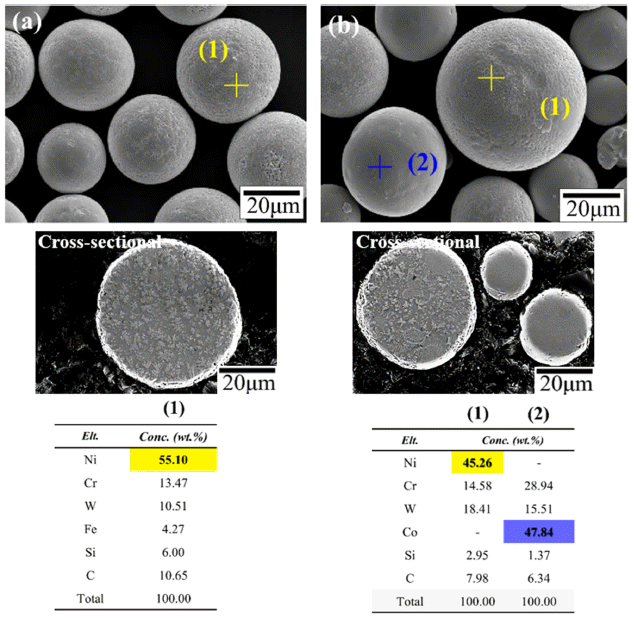
In this study, the formation, microstructure, and wear properties of Colmonoy 88 (Ni-17W-15Cr-3B-4Si wt.%) + Stellite 1 (Co-32Cr-17W wt.%) coating layers fabricated by high-velocity oxygen fuel (HVOF) spraying are investigated. Colmonoy 88 and Stellite 1 powders were mixed at a ratio of 1:0 and 5:5 vol.%. HVOF sprayed selffluxing composite coating layers were fabricated using the mixed powder feedstocks. The microstructures and wear properties of the composite coating layers are controlled via a high-frequency heat treatment. The two coating layers are composed of γ-Ni, Ni3B, W2B, and Cr23C6 phases. Co peaks are detected after the addition of Stellite 1 powder. Moreover, the WCrB2 hard phase is detected in all coating layers after the high-frequency heat treatment. Porosities were changed from 0.44% (Colmonoy 88) to 3.89% (Colmonoy 88 + ST#1) as the content of Stellite 1 powder increased. And porosity is denoted as 0.3% or less by inducing high-frequency heat treatment. The wear results confirm that the wear property significantly improves after the high-frequency heat treatment, because of the presence of wellcontrolled defects in the coating layers. The wear surfaces of the coated layers are observed and a wear mechanism for the Ni-based self-fluxing composite coating layers is proposed.
 First
First Prev
Prev

TOP

