 KPMI
KPMI

Search
- Page Path
- HOME > Search
Research Articles
- [English]
- Influence of Ta Addition on Austenite Stability and Strain-Induced Martensite Transformation in Sintered Fe-7Mn Alloy
- Seunghyeok Choi, Sungjin Kim, Junho Lee, Seok-Jae Lee
- J Powder Mater. 2026;33(2):119-129. Published online April 30, 2026
- DOI: https://doi.org/10.4150/jpm.2026.00066
- 1,110 View
- 9 Download
-
 Abstract
 PDF
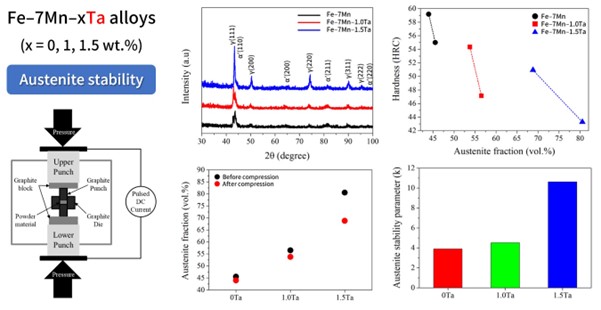
PDF - This study examines the effect of Ta addition on austenite stability and strain-induced martensitic transformation behavior in Fe–7Mn alloys fabricated by powder metallurgy. Fe–7Mn–xTa alloys (x = 0, 1, and 1.5 wt.%) were produced via mechanical alloying followed by spark plasma sintering, achieving nearly full relative density for all compositions. With increasing Ta content, the initial retained austenite fraction significantly increased, reaching 80.55 vol.% in the Fe–7Mn–1.5Ta alloy. EBSD analysis revealed a grain coarsening tendency with Ta addition, indicating that the increase in retained austenite fraction could not be explained solely by grain refinement. Compression tests up to 20% strain showed strain-induced martensitic transformation in all alloys, with substantially more pronounced transformation observed in the Fe–7Mn–1.5Ta alloy. The Burke–Matsumura–Tsuchida model showed that the austenite stability parameter (k), where higher values indicate lower stability, increased from 3.89 to 10.62 with Ta addition. Ta thus exhibits a dual effect: promoting retained austenite after sintering while reducing its deformation stability. The hardening efficiency per unit martensite fraction decreased with Ta content, and a preliminary correlation between k and hardening efficiency suggests that austenite stability governs the mechanical response of Fe–Mn-based alloys.
- [English]
- The Effect of Aluminum Powder Size on the Structure and Mechanical Properties of Foam
- Seunghyeok Choi, Sungjin Kim, Tae-Young Ahn, Yu-Song Choi, Jae-Gil Jung, Seung Bae Son, Seok-Jae Lee
- J Powder Mater. 2025;32(3):232-243. Published online June 30, 2025
- DOI: https://doi.org/10.4150/jpm.2025.00157
- 3,301 View
- 104 Download
- 6 Citations
-
Abstract
PDF
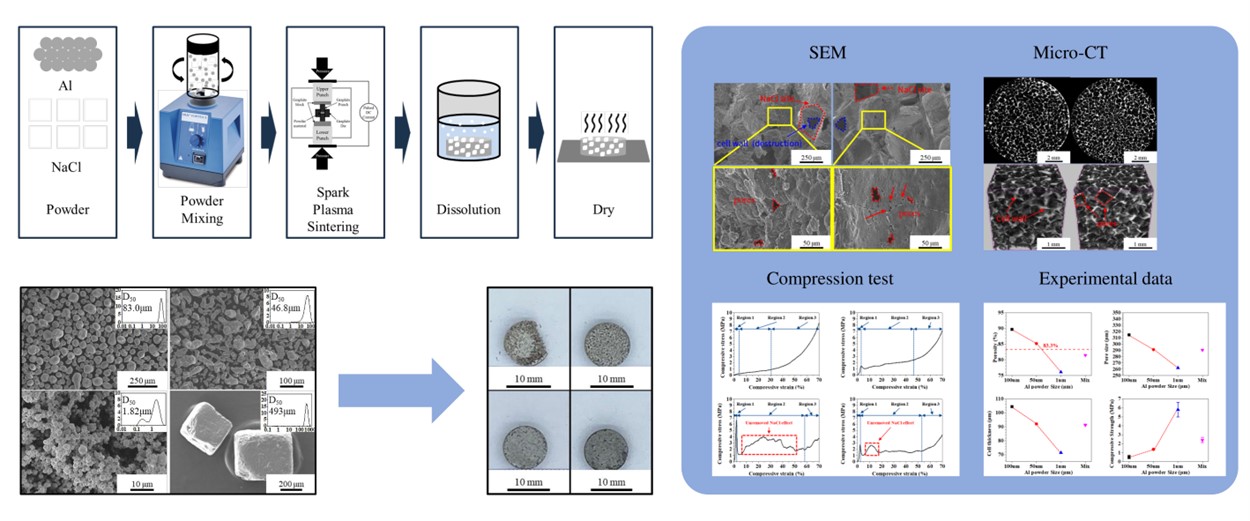
- In this study, we analyzed the structural and mechanical properties of aluminum foams fabricated using aluminum powders of varying sizes and mixtures. The effects of sintering and pore structure at each size on the integrity and mechanical properties of the foams were investigated. Structural characteristics were examined using scanning electron microscopy and micro–computed tomography, while mechanical properties were evaluated through compression testing. The experimental results demonstrated that smaller powder sizes improved foam integrity, reduced porosity and pore size, and resulted in thinner cell walls. In combination, these effects increased compressive strength as the powder size decreased. The findings of this study contribute to the understanding and improvement of the mechanical properties of aluminum foams and highlight their potential for use in a wide range of applications.
-
Citations
Citations to this article as recorded by
- Sustainable Manufacturing of Graphene–Aluminum Composites: A Comparative Life Cycle Assessment
Xinwei Yang, Qian Peng, Changke Chen, Qingcui Liu, Yudai Huang
Journal of Sustainable Metallurgy.2026; 12(1): 727. CrossRef - Effect of powder size and sintering time on the induction sintering behavior of aluminum fabricated by UHFIS
Hıdır Sercan Çubuk
Turkish Journal of Engineering.2026; 10(2): 396. CrossRef - A Powder-Metallurgical Route to Ag2(Te,S) Compounds and Their Thermoelectric Properties
Seungki Jo, Yoojeong Ji, Linh Ba Vu, Kyung Tae Kim
Journal of Powder Materials.2026; 33(3): 214. CrossRef - Comparative Densification, Microstructure, and Mechanical Response of Five-Layer Al-Al2O3 Functionally Graded Materials Processed by Vacuum Sintering and Spark Plasma Sintering
Satyasaibaba Pitta, Ranga Janardhana Ginka, Balakrishna Bhanavathu
Journal of The Institution of Engineers (India): Series D.2026;[Epub] CrossRef - Fabrication and Characterization of Porous Aluminum Manufactured via Multiple Pore Former
Mahabub Alam Rudro, Md. Mostafa Kamal, Md. Shahriar Nazim, Md. Abdul Kader, Md. Sajjad Hasan
Advances in Materials Science and Engineering.2026;[Epub] CrossRef - Optimization of fine-grained powder addition for strengthening and wear resistance in heterostructured 2219 Al alloys fabricated by powder metallurgy
Yiping Lv, Haohao Zou, Hongfei Yuan, Yuning Zhang, Huadong Ye, Weiwei Zhu, Shengjian Zhou, Xu Ran
Powder Metallurgy.2026;[Epub] CrossRef
- Sustainable Manufacturing of Graphene–Aluminum Composites: A Comparative Life Cycle Assessment
 First
First Prev
Prev

TOP

