 KPMI
KPMI

Search
- Page Path
- HOME > Search
- [Korean]
- Study on Particle Shape Control and Characterization of SUS316L Flake Powder Fabricated by Wet Milling Process
- Jae Hyeok Wi, Si Hong Ryu, Seong Eui Lee
- J Powder Mater. 2026;33(1):37-43. Published online February 28, 2026
- DOI: https://doi.org/10.4150/jpm.2026.00017
- 2,104 View
- 31 Download
-
 Abstract
 PDF
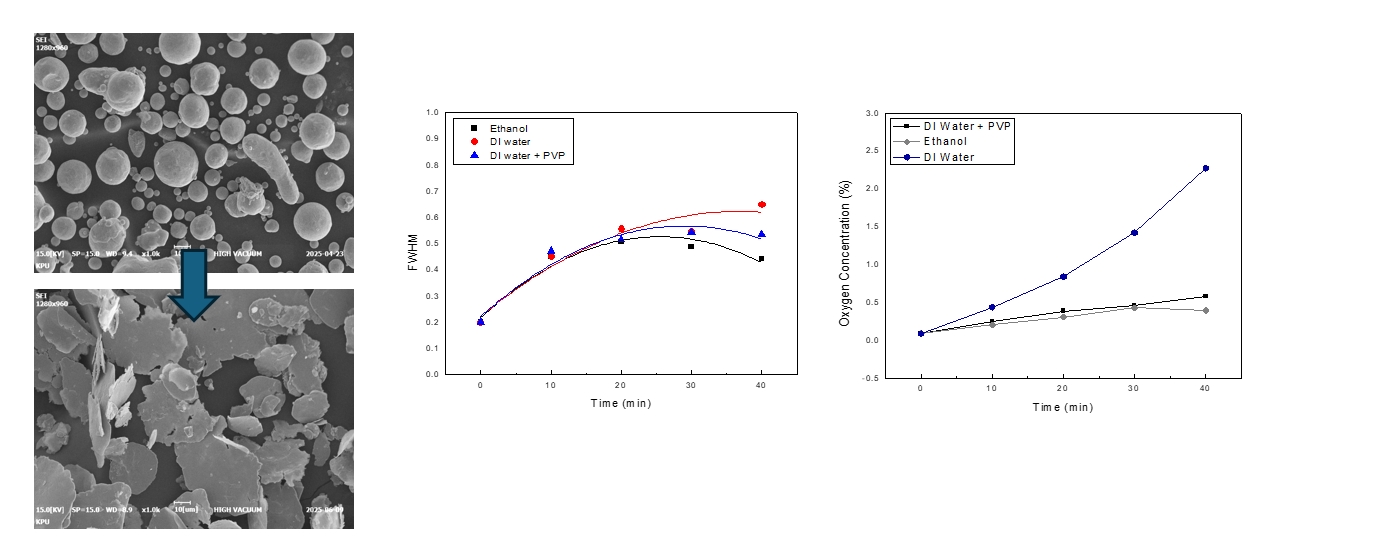
PDF - In this study, a particle shape control process was developed to fabricate flake-like SUS316L powders about 20 µm for application in semiconductor gas filters. The Flake powder was produced through a wet milling process using a Planetary Mill by varying the rotation speed, milling time, solvent, and polyvinylpyrrolidone (PVP) dispersant conditions. The fabricated powders were then characterized to evaluate their morphological and phase transformation behaviors. In the ethanol-based Planetary Milling process, as the rotation speed increased from 300, 400, 500 rpm, the powder morphology was observed to gradually change from spherical to flake-like due to the increase in milling energy. According to the XRD, as the rotation speed increased, a phase transformation from austenite to martensite occurred due to the increase in heat generation and collisions between the powder and balls. In addition, an increase in Full Width at Half Maximum (FWHM) was observed, indicating a decrease in crystallinity. Under different solvent and dispersant conditions, the addition of 5 wt% PVP to the deionized water (DI Water) solvent suppressed particle fracture and produced more uniform flake-like particles compared with the DI Water process without PVP. In addition, a smaller FWHM and reduced oxygen content were observed.
- [English]
- Preparation of Flake-shape Cobalt Powders by High-Energy Ball Milling for rSOC Current Collectors
- Poong-Yeon Kim, Min-Jeong Lee, Hyeon Ju Kim, Su-Jin Yun, Si Young Chang, Jung-Yeul Yun
- J Powder Mater. 2025;32(5):383-389. Published online October 31, 2025
- DOI: https://doi.org/10.4150/jpm.2025.00241
- 1,236 View
- 37 Download
-
Abstract
PDF
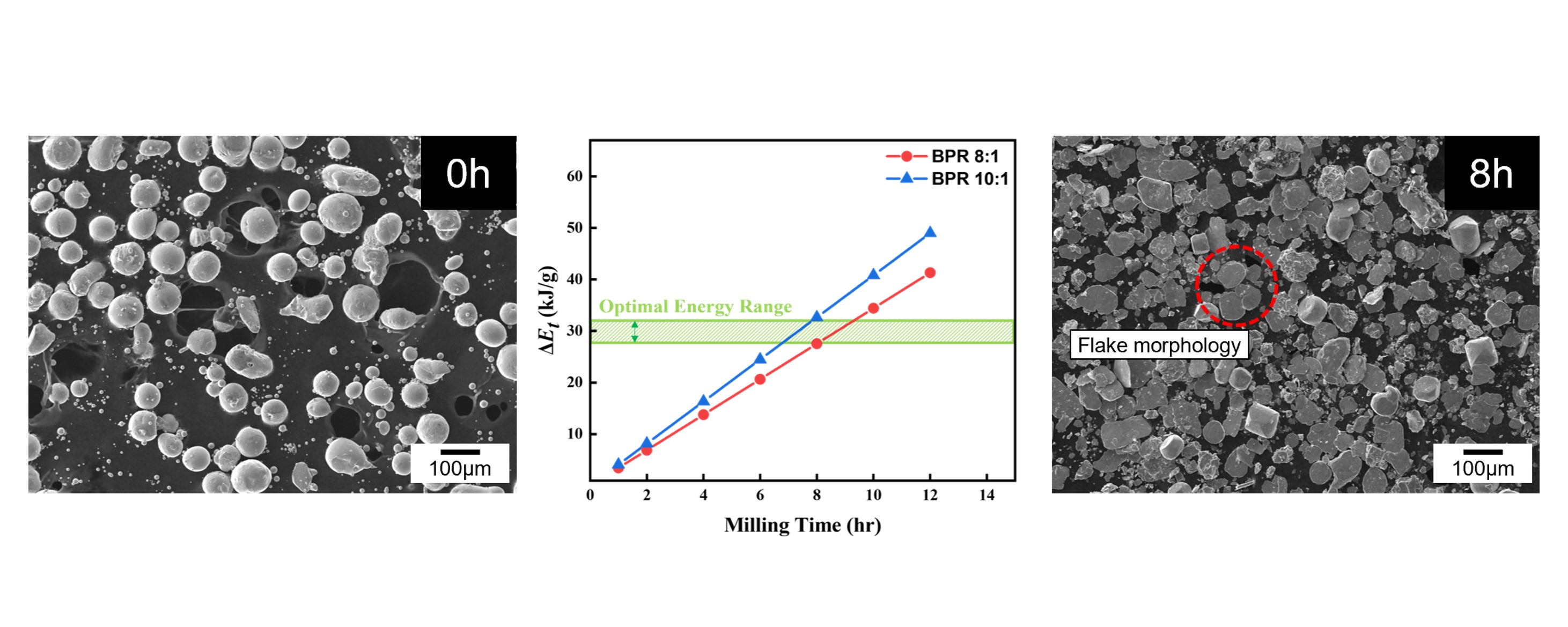
- Reversible solid oxide cells (rSOCs), which enable two-way conversion between electricity and hydrogen, have gained attention with the rise of hydrogen energy. However, foam-type current collectors in rSOC stacks exhibit poor structural controllability and limited electrode contact area. To address these limitations, this study aimed to convert spherical cobalt powders into flake-type morphology via high-energy ball milling, as a preliminary step toward fabricating flake-based current collectors. Milling parameters—specifically, the ball-to-powder ratio (BPR), milling time, and process control agent (PCA) content—were varied. At an 8:1 BPR, over 90% of the powder became flake-shaped after 8 hours, while extended milling caused cold welding. In contrast, a 10:1 BPR resulted in dominant fragmentation. The Burgio–Rojac model quantified energy input and defined the optimal range for flake formation. Increasing the PCA to 4 wt% delayed flake formation to 16 hours and induced cold welding, as shown by bimodal particle size distributions. These results support the development of Co-based current collectors for use in rSOCs.
- [Korean]
- Preparation of Nanosized Gd2O3:Eu3+ Red Phosphor Coated on Mica Flake and Its Luminescent Property
- Se-Min Ban, Jeong Min Park, Kyeong Youl Jung, Byung-Ki Choi, Kwang-Jung Kang, Myung Chang Kang, Dae-Sung Kim
- J Korean Powder Metall Inst. 2017;24(6):457-463. Published online December 1, 2017
- DOI: https://doi.org/10.4150/KPMI.2017.24.6.457

- 1,647 View
- 7 Download
- 1 Citations
-
Abstract
PDF
Nanosized Gd2O3:Eu3+ red phosphor is prepared using a template method from metal salt impregnated into a crystalline cellulose and is dispersed using a bead mill wet process. The driving force of the surface coating between Gd2O3:Eu3+ and mica is induced by the Coulomb force. The red phosphor nanosol is effectively coated on mica flakes by the electrostatic interaction between positively charged Gd2O3:Eu3+ and negatively charged mica above pH 6. To prepare Gd2O3:Eu3+-coated mica (Gd2O3:Eu/mica), the coating conditions are optimized, including the stirring temperature, pH, calcination temperature, and coating amount (wt%) of Gd2O3:Eu3+. In spite of the low luminescence of the Gd2O3:Eu/mica, the luminescent property is recovered after calcination above 600°C and is enhanced by increasing the Gd2O3:Eu3+ coating amount. The Gd2O3:Eu/mica is characterized using X-ray diffraction, field emission scanning electron microscopy, zeta potential measurements, and fluorescence spectrometer analysis.
-
Citations
Citations to this article as recorded by
- Optimization of dispersed LaPO4:Tb nanosol and their photoluminescence properties
Mahboob Ullah, Se-Min Ban, Dae-Sung Kim
Optical Materials.2019; 97: 109366. CrossRef
- Optimization of dispersed LaPO4:Tb nanosol and their photoluminescence properties
- [Korean]
- Fabrication of Silver Flake Powder by the Mechanical Milling Process
- Hae-Young Jeong, Gil-Geun Lee
- J Korean Powder Metall Inst. 2016;23(1):54-60. Published online February 1, 2016
- DOI: https://doi.org/10.4150/KPMI.2016.23.1.54
- 1,364 View
- 3 Download
- 1 Citations
-
Abstract
PDF
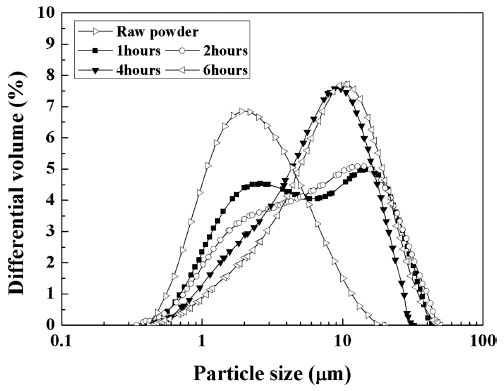
This study focuses on fabricating silver flake powder by a mechanical milling process and investigating the formation of flake-shaped particles during milling. The silver flake powder is fabricated by varying the mechanical milling parameters such as the amount of powder, ball size, impeller rotation speed, and milling time of the attrition ballmill. The particle size of the silver flake powder decreases with increasing amount of powder; however, it increases with increasing impeller rotation speed. The change in the particle size of the silver flake powder is analyzed based on elastic collision between the balls, taking energy loss of the balls due to the powder into consideration. The change in the particle size of the silver flake powder with mechanical milling parameters is consistent with the change in the diameter of the elastic deformation contact area of the ball, due to the collision between the balls, with milling parameters. The flake-shaped silver particles are formed at the elastic deformation contact area of the ball due to the collision.
-
Citations
Citations to this article as recorded by- Fabrication of WC/Co composite powder from oxide of WC/Co hardmetal scrap by carbothermal reduction process
Gil-Geun Lee, Young Soo Lim
journal of Korean Powder Metallurgy Institute.2018; 25(3): 240. CrossRef
- Fabrication of WC/Co composite powder from oxide of WC/Co hardmetal scrap by carbothermal reduction process
- [Korean]
- Effect of Mechanical Milling Parameters on the Particle Size of Silver Flake
- Gil-Geun Lee, Hae-Young Jeong
- J Korean Powder Metall Inst. 2014;21(4):307-312. Published online August 1, 2014
- DOI: https://doi.org/10.4150/KPMI.2014.21.4.307

- 1,453 View
- 9 Download
- 1 Citations
-
Abstract
PDF
This study is focused on investigating the relation between the particle size of silver flake powder and mechanical milling parameters. Mechanical milling parameters such as ball size, impeller rotation speed and milling time of the attrition ball-mill were controlled to produce silver flake powder. The particle size of the silver flake powder increased with increasing ball size and impeller rotation speed. The change of the particle size of the silver flake powder with mechanical milling parameters was analyzed based on balls motion in the mill container of the attrition ballmill. The silver flake particles were formed at the elastic deformation area of the ball due to the collision between balls. The change of the particle size of the silver flake powder with mechanical milling parameters well consists with the change of the collision energy of ball with parameters mentioned above.
-
Citations
Citations to this article as recorded by- Fabrication of Silver Flake Powder by the Mechanical Milling Process
Hae-Young Jeong, Gil-Geun Lee
Journal of Korean Powder Metallurgy Institute.2016; 23(1): 54. CrossRef
- Fabrication of Silver Flake Powder by the Mechanical Milling Process
 First
First Prev
Prev

TOP

